







 Image by Grok
The Stone Bridge of Grace
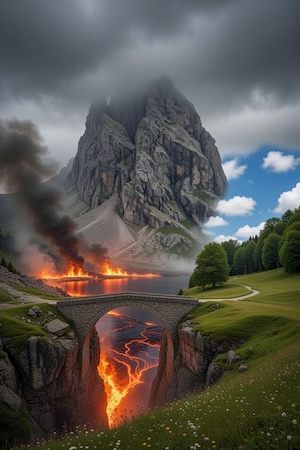
There once lived a people who resided on a high, barren mountain, living their whole lives there on the mountain peak. However, they could see that there was a place of infinite beauty far below, stretching to the horizon—a place they called Paradise. It could be seen thousands of feet below—so close, but so hard to reach, because in doing so one had to descend down a slippery slope that passed terrifyingly close to a lake of fire.
Life was hard on the rocky mountain, with only a few oases to relieve the boredom and frequent misery. Their only choice was the barroom or the church.
The church provided fellowship and guidance in the form of a map that traced a long and arduous trail around the mountain to the other side, with a bridge that promised a way over the lake of fire. The church also revealed an infallible guiding star to keep them from wandering off the trail.
Now the barroom, on the other hand, was a rowdy and raucous place where everyone slapped each other on the back, congratulating themselves on their worldly wisdom of "eat, drink, and be merry, for tomorrow you may die." Unlike the fools who suffered in humility over at the church, they, in their worldly wisdom, figured that they could navigate the slippery slope and find a shortcut to paradise.
So the people of the church began their long journey down the mountain, map in hand and their eyes on the star. It was long and difficult, but they had one very valuable thing to cling to—faith. As they went along their journey, they could hear from far above the revelry of the barroom crowd as they drank enough courage to start their descent down the slippery slope.
And sure enough, the people of the barroom were starting to slip and slide down the slope. Some with their treasured idols, sure that these would bring them success. Some with half-empty bottles that gave them false hope and dreams of grandeur. And some, with empty bottles and no hope at all—each and every one falling head over heels into the abyss.
As they walked around the mountain, the people of the church could hear the screams of the people of the barroom as they slipped and fell into the lake of fire. And they whispered to themselves that but for the grace of the star and the guidance of the map, they would be sliding down that very same slope.
On that fateful day, as the barroom was emptied and the church was vindicated, the people of the church came to a great stone bridge far above the lake of fire, and on the other side lay the promised land that they had seen from the mountaintop. And with the promise of everlasting joy at the side of the God of the universe, they lived happily ever after.
Reflection: Conversion from the allegorical barroom to the generalities of a church does not whisk a person away to a new landscape. It does not replace the mountain with a meadow. It does not remove the lake of fire or silence the barroom's laughter. Conversion simply gives a man a map and a star—and the courage to trust them.
For the people of the church, the mountain did not change. They changed. The rhythm of life is immutable, unchanging—you either learn to walk in step with that rhythm or be broken upon it.
As they began their long descent around the mountain, they still felt the same wind cutting through their coats. They still stumbled on the same rocks that had bruised their feet since childhood. They still heard the same temptations echoing from above—the laughter, the bravado, the promises of shortcuts. Their lives were not changed in kind, but in spirit. They walked the same world, but now they walked it toward something.
And this is the quiet miracle of Grace—that conversion does not erase the ordinary; it transfigures it. The map does not redraw the terrain. The Star does not silence the night. But together they give a man the one thing he never had before—a direction that is true.
For what is the conscience of a man, if not the conscience of all mankind through the inherited memory of the map? What is moral clarity but the faint echo of the Star? Every generation receives its bearings from those who walked before, and every conscience is shaped by a moral inheritance older than any individual life. A society that forgets this inheritance does not become free—it becomes blind. It loses not only the map but the very idea that a map exists.
And once the map is forgotten, the slippery slope becomes irresistible.
For without a transcendent Judge—One who sees us as we are and holds us accountable—there is no rein on man's inhumanity to man. When God is dismissed, judgment does not disappear; it merely shifts into human hands, where it becomes infinitely more dangerous. The lake of fire does not vanish simply because the barroom denies it.
So the people of the church walked on, humbled by what they heard from above and sobered by what they saw below. And when at last they reached the far side of the mountain, they found the mighty stone bridge to eternal joy—not built by their cleverness, not earned by their endurance, but by the Grace of the brightest Star in the universe—Jesus Christ.
They crossed it not because they were better, but because they trusted the map and followed the Star.
And in that trust, they found the Paradise they had glimpsed from the beginning—the homeland their souls had always known—so close, and yet so very far away.
Amen.