








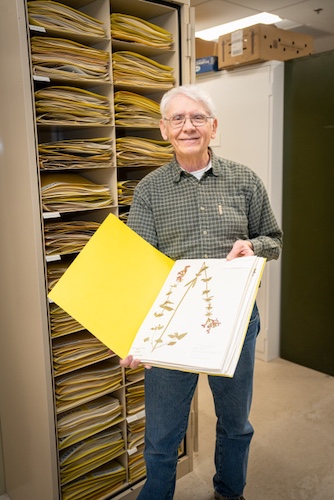
 Bill Norris displaying some of the urban flora found in and around Silver City during researchSILVER CITY, NM — At a university dedicated primarily to teaching, pursuing high-level research requires a rare degree of dedication. Highlighting this commitment to academic excellence, Western New Mexico University (WNMU) Professor of Biology in the Department of Natural Sciences, Bill Norris, Ph.D., recently presented findings from a massive, multi-year study exploring the flora and fauna of Silver City.
Since 2022, Norris has led a diverse team of 15 collaborators—ranging from botanists to expert photographers—to document the municipality's botanical landscape. This ambitious project is set to become the first published urban flora study of a municipality in the Western United States, joining a select group of only 5 such studies nationwide.
While the current study began in earnest four years ago, it builds upon a legacy of botanical curiosity dating back to 1851. Over the last century and a half, various researchers have collected approximately 9,000 specimens within the region. However, Norris' team has accelerated this work at an unprecedented pace.
"We have doubled the collection of specimens in our herbarium since 2021," Norris stated, noting that the team has identified over 500 plant species within city limits to date.
The research required the team first to establish rigorous geographical boundaries and create custom mapping for the project. Despite the demands of a full teaching schedule, the team spends the busy growing season in the field. To ensure environmental sustainability, the team follows a strict protocol: they collect physical samples only when the plant population is robust enough to withstand the loss. For rare or isolated growths, the team uses high-resolution photography to document the find.
The study provides critical data on the resilience of local ecosystems. Norris reported that approximately 70% to 75% of the flora in Silver City remains native. This is a significant finding compared to regions like California, where non-native species often dominate the landscape.
"It sets a stage and establishes a baseline for flora at two different points in time for future research," said Norris. Determining "nativity" is a complex science; the team cross-referenced 150 years of records to determine whether a plant has a history of occurring locally without records of its appearance in Europe or other global regions. Norris noted that plant distributions are fluid, citing that some local grasses that have been present for 10,000 years were not here 20,000 years ago due to natural migration.
The fieldwork has taken the team to every corner of the community, from public landmarks to private acreage. Norris highlighted several key areas for rare and non-native plant viewing, including:
– Boston Hill and San Vicente Creek
– St. Vincent DePaul Cemetery
– The intersection of Hill and Mississippi Streets
– Mill Road access points
One of the project's highlights was the discovery of Wheel Milkweed on private land, documented with the landowner's permission. These discoveries are currently in various states of processing—being identified, mounted, labeled, and uploaded to the digital herbarium portal.
With one year of fieldwork remaining, the team is entering a "treasure hunt" phase, searching for roughly 100 native plants that historical records suggest are in the area but have yet to be found.
Upon the conclusion of the fifth year of research, the team plans to publish their findings, providing the scientific community with a definitive look at the botanical life of a Western U.S. municipality. WNMU commends Norris and his fifteen teammates for their extraordinary "extra mile" efforts, proving that even at a teaching-focused institution, world-class research is blooming.