







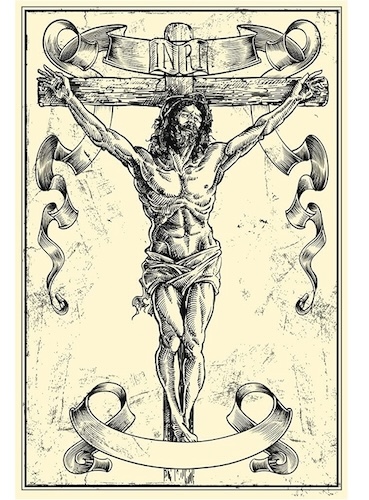
"On a hill far away stood an old rugged cross, the emblem of suffering and shame. And I love that old cross where the dearest and best, for a world of lost sinners was slain."
Today, that hill, that cross, that sacrifice seems nearer than ever. Thousands of years and miles have not changed our fallen nature one tiny bit — it has only spread its dominion into every corner of our world.
The great liberties we enjoy have been bought at a high price. Our nation was built on blood, sweat, and tears. But in the end, it was blood that gave us the freedom that so many of us take for granted. And in taking liberty for granted, we have become soft and complacent. In our comfort, we've allowed those who trade liberty for secular promises to subvert our culture and our government. We must remember that it was our common Christian values that shaped liberty for all.
We, in this modern era, have forgotten the blood shed by our forebears to keep us free. We have forgotten about the blood shed by the colonists who founded this nation and those who died in blood-soaked soil to end slavery. We have forgotten the blood shed by tens of millions in World Wars that threatened the extinction of Western civilization. And too many have forgotten that a man called Jesus Christ shed His blood for all of mankind, and it was the blood of His disciples that gave us Christianity. It was the blood of Christian soldiers that helped solidify Western civilization. And it was primarily the blood of Christians that brought this nation into existence — it was always about blood.
To that end, let me tell you a short story about Easter. It is not about eggs or rabbits, nor is it about fancy dress or bonnets. It is about a man — an incredibly special man. He was the Son of God. But the people did not know Him because He grew to manhood in a lowly backwater village called Nazareth.
From the beginning, He knew that He had a special mission here on Earth. He had come to wash away the sins of mankind with His own blood — to suffer and die as a mortal creature at the hands of those He created.
In His journey to the Cross, He gained a following of disciples, all with their own crosses to bear. This humble man, a carpenter by trade, drew the lost and hopeless to His side through simple acts of mercy and healing.
This man, known as Jesus of Nazareth, sat down on a hill and gave the promise of salvation through grace and mercy to the poor in spirit lost in the darkness of a cruel and sinful world. Slowly, His light began to illuminate the darkness, and the people began to take notice. They hungered for a savior to deliver them from the misery of the world — not understanding that He was pointing the way to a better world through love. Love of God — love of neighbor — love of goodness, grace, and mercy.
But the Sanhedrin Council within the Jewish Temple could not abide this upstart Rabbi named Jesus — a man claiming to be the bearer of truth and the promise of Heaven for those who choose to follow Him. The Council's clamor for the crucifixion of this man, called the Messiah by his followers, soon had the Roman occupiers come to see Him as a threat to their power in the region.
With the mob crying for His blood, the Roman soldiers beat and scourged Jesus. They placed a crown of thorns on His head and a heavy wooden cross on His lacerated back and forced Him along the streets to the place of execution.
This brings us to a stark and wretched hill, in a place outside Jerusalem called Calvary, the "place of the skull." Thus, in the darkness of that afternoon on the Cross, amidst suffocating misery, came the anguished cry of the man called Jesus: "My God, my God, why hast Thou forsaken me?" But as Christ, He knew that by taking on the sins of humanity, the Father must turn from the Son at this moment of punishment. "For God so loved the world that He gave His only begotten Son, that whosoever believeth in Him should not perish, but have everlasting life."
That day brought all the myths of antiquity into reality. The sacrifice given to us by the Lamb of God changed the course of history and brought the light of Christianity into the world. Will our world now turn its backside to that sacrifice? No, not here, not today—not ever.
So I'll cherish the old rugged cross, till my trophies at last I lay down; I will cling to the old rugged cross and exchange it someday for a crown.