







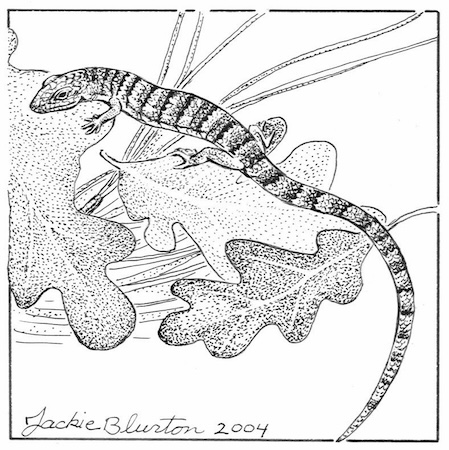
 Art by Jackie Blurton
Nature Note by Dr. Roland Shook
Alligator lizards can be found widely distributed throughout much of the Americas, North Africa, Europe, the Middle East, and China. In this family there is a tendency for the reduction of limbs, from dwarfing of the limbs in some species in South America to the complete loss of limbs in the glass lizards of both the Old and New Worlds.
The Arizona Alligator Lizard is the only member of this family found in New Mexico, and it is confined to the southwestern corner of the state. The adults are from 3 to 5 inches long, pale gray or brown above with distinctive wavy crossbars. There are conspicuous black and white spots on the upper jaw.
Alligator lizards generally seek moist environments in the foothills and mountains. In New Mexico this species frequents pine-oak woodlands and moist canyon floors. It can also be found in drier habitats, but in these it seeks leaf litter, rodent burrows and woodrat nests where the moisture level is high.
It's primarily diurnal but is sometimes abroad at dusk or after dark. This species is mostly terrestrial, but it also occasionally climbs. Owing to their cryptic coloration they are often heard rustling through leaf litter before they are seen. The females mate in the late summer but do not lay eggs until the spring or early summer of the next year. The normal clutch size is between 9 to 15 eggs.
Arizona Alligator Lizards feed primarily on invertebrates which include grasshoppers, caterpillars, praying mantids, moths and scorpions.
When caught, many alligator lizards attempt to bite and may writhe around smearing the captor with feces. When a potential predator grabs the tail, it is readily lost as the former owner tries to escape.