







 Art by Jackie Blurton
Nature Notes by Dr. Roland Shook.
Black-crowned Night Heron
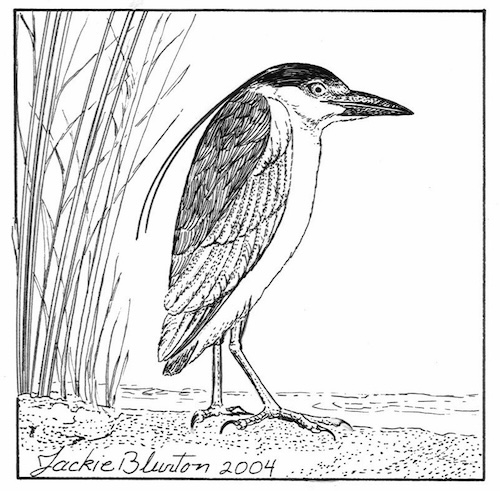
Herons are primarily long-legged, slender-necked waders who frequent marshes, mud flats, and shorelines. Most members of this group have crests or plumes (as shown in this illustration), especially in the breeding season.
This species is smaller and stockier than most herons with relatively short legs and a short bill. The crown and back are black, the wings gray, and the under parts are white.
As the common name would indicate, Black-crowned Night Herons are primarily active at night often roosting in small groups during the day in trees or marshes. This species characteristically stands with its neck pulled in giving it a hunched-up appearance.
Like many herons, this species feeds on a wide variety of prey items. Analysis of 117 stomachs reveals a diet of 52% fish, 22% crustaceans such as crayfish, 16% aquatic insects, 6% frogs, and 3% mice and rats.
In summer, this species is one of the most widely distributed and most common marsh birds in the state. Black-crowned Night Herons usually nest in small colonies or rookeries, often in association with other species of similar habits such as Snowy Egrets. The nests are found in trees or on mats of rushes or cattails.
"The curfew over much of rural North America is the 'quawk' of this night heron as it slowly flaps its way through the gathering dusk." — H.H. Collins.