







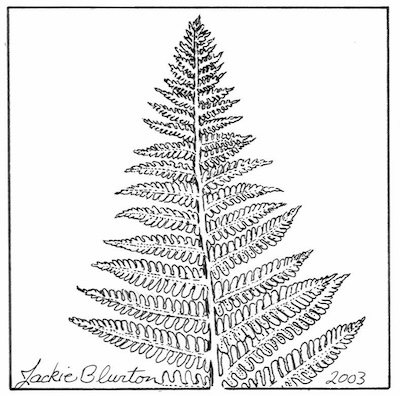
Bracken Fern
Art by Jackie Blurton
Nature Note by the late Dr. Roland Shook
Ferns are vascular plants (having tissues that conduct fluids) which have large feathery leaves. Typically, the leaves unroll from the tip during growth. In addition to leaves, ferns also have stems and roots. In some the stem is much reduced, while in others, like many tropical forms, the stem forms a tall column, hence the name "tree fern."
There are two growth forms in ferns, the sporophyte generation and the gametophyte generation. The former is the conspicuous feather-like, spore producing plant. The spores are produced on the undersides of the leaves or at times on special fronds. The gametophyte generation produces gametes or sex-cells.
This form is very small and may not be seen or recognized by most individuals. The two generations alternate from sporophyte with spores, to gametophyte with sperm and eggs, and back to sporophyte.
Ferns, like mosses, are widespread and locally abundant, especially in moist woodlands. Yet despite their availability, wildlife uses them only to a minor extent. The minute size of the spores eliminates them from significance as food. However, their leaves are eaten by several wildlife species such as turkeys, grouses, hares, and deer.