








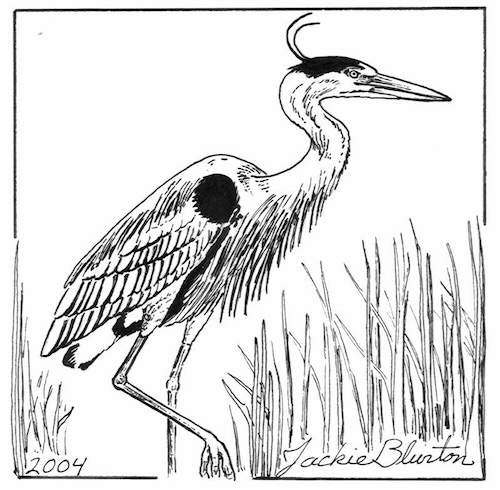
 Great Blue Heron
Art by Jackie Blurton
Nature Note by Dr. Roland Shook
Herons are long-legged wading birds with long necks and long, pointed bills. The Great Blue Heron is the largest heron in the United States. The adults and young are primarily bluish-gray. The crown of the lighter head is dark and often shows dark plume-like feathers. In flight, the wing beats are slow and steady. Herons characteristically pull their necks back in an "S" shaped fashion when they are flying as opposed to cranes which fly with their necks outstretched. A knowledgeable birder can identify herons at great distances using this field characteristic.
Great Blue Herons are a noisy lot, frequently calling in flight with a deep croaking call. In general, these are solitary birds except during the breeding season when they nest in colonies called rookeries. The numerous nests are often placed high up in the top of cottonwoods or other similar trees.
This species hunts by standing motionless, often in shallow water, for long periods of time until some unsuspecting fish or frog swims by. The long, very quick, sharp bill is a wonderful adaptation for securing a meal.
For some yet unexplainable reason, the number of Great Blue Herons in the Gila Valley has been steadily declining over the past several years. At one time there was a large active rookery along the Gila River near Cliff which is no longer being used by this species.
Herons can be seen at Lake Roberts and along the Gila River.