







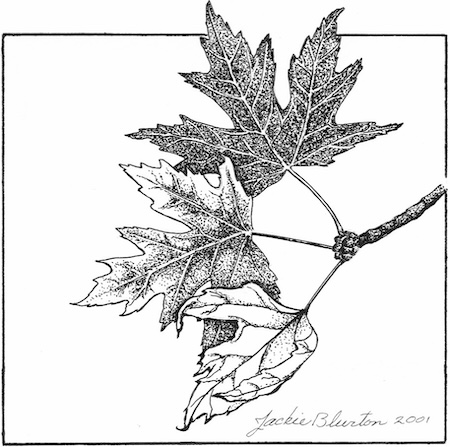
 Art by Jackie Blurton
Nature Note by the late Dr. Roland Shook
During the fall, the leaves of deciduous trees change color and fall to the ground. This process is brought about by a series of interactions between the plant and its environment. Lower temperatures, decreasing day length, lack of water or changes in the leaf structure, cause a weakening of the attachment of the leaf to the branch. The leaf then falls from the tree under the added stress of wind or rain.
Inside the leaf, a number of pigments are found that are necessary in converting sunlight to sugars. The dominant one, chlorophyll, gives the leaf its green color. During the fall chlorophyll breaks down exposing the red, yellow, orange and brown pigments. The final leaf color depends on the combination of these pigments.