








Can a DSA Winner Be Sworn Into Office?
By Mike Bibb
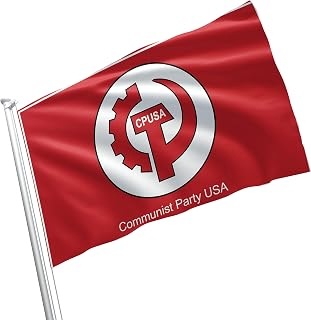 Communist Party of the USA flag
"The Senators and Representatives before mentioned, and the members of the several state legislatures, and all executive and judicial officers, both of the United States and of the several states, shall be bound by oath or affirmation, to support this Constitution; but no religious test shall ever be required as a qualification to any office or public trust under the United States." — Article VI, par. 3, United States Constitution.
_____________________________________________________________
With the rising popularity of the Democratic-Socialists of America party and its candidates making gains in several primary elections across the country, can these people actually be sworn into office if they go on to win in the general election?
It would seem, at least from reading provisions of Art. VI of the U.S. Constitution, that the "shall be bound by oath and affirmation, to support this Constitution" requirement probably does not square with DSA's socialist/communist concepts and narratives.
As a result, failure to comply would, at least in principle, be a disqualification from holding any elective, or appointive, federal, state, city and county government office.
Ben Franklin reminded us over two hundred years ago, our founders established a "Republic." We pledge our allegiance "to the flag of the United States and to the Republic for which it stands."
There is one national flag and 50 states and several territorial flags representing our nation and its "Bylaws" — the Constitution.
Yet, there seems to be an obvious difference between what socialists and communists think and say compared to the provisions contained within the Constitution they will be sworn to support and defend.
These deviations are not minor, and I hardly expect a socialist/communist office holder to change their political philosophies just because the Constitution required it 235 years ago.
Only then, the terms socialism and communism hadn't been minted — but the concepts have been in existence since one person wanted to control and manage another person's life and property.
The Constitution, along with the English Magna Carta in 1215, is/was an attempt to establish people had the right to decide their own affairs without the minions of government telling them when, where and how to do it.
Nor, was the idea of being herded like cattle and sheep by the King's shepherds, and then taxed for various goods and commodities, compatible with early American Colonist's independent thought.
Magna Carta went through several reiterations and ultimately became influential in our ancestors' composition and ratification of our own Constitution on Dec. 15, 1791.
The first ten amendments to the Constitution are known as The Bill of Rights.
Of course, we've strayed from these ideas, but the logic remains intact, because it's written in ink and approved by the people we select to represent us.
So, does this mean if a socialist/communist is elected to office, do we have to accept it?
Up to a point.
Everyone is familiar with the 5th Amendment, particularly its guarantee no person can be forced to be a witness against himself. Dr. Anthony Fauci repeated this provision 111 times during a recent Congressional Hearing regarding his involvement in the COVID-19 pandemic a few years ago.
Inflicting a sort of "coup de grace" to his once sterling reputation.
However, the 5th Amendment also stipulates "nor shall private property be taken for public use, without just compensation."
In effect, a specific prohibition against the basic notions of socialism and communism. For the very evident fact socialism and communism is based upon the premise that private property, including a person's money, must be taken and shared with everyone else.
Money is property. It is merely a person's means to exchange one form of property for another. Money for rent payments, or money for a house mortgage, or money for a stock purchase, or money for a new F-150, or money to buy food.
In a socialist/communist society, private wealth and money is despised, mediocracy encouraged, and poverty accepted. Except, of course, among the bureaucratic elites who have conveniently exempted themselves from their own rules.
The rise in socialist/communist popularity in the U.S. has prompted an exodus of money and wealth from areas where communism is gaining acceptance.
Consequently, to compensate for a shrinking economic base, socialism automatically increases costs of goods and services because the tax base has also dwindled as people and businesses have left.
Likewise, communistic propaganda in the media and academia is being exposed for the lie it is. Taking from the producers of society and giving it to the nonproducers only results in producers moving their assets and money to a less larcenous environment.
The nonproducers remain nonproducers, while previously employed producers (workers) are reduced to peasants, working for peasant's wages.
Eventually, the money runs out — fewer working people to tax or property to confiscate.
Not difficult to figure out. Those who can, get out — while they can.
A financially deficient economic system will continue to deteriorate until a financially advantageous system takes its place.
Socialist-communist societies remain in control for as long as forced compliance is imposed by an authoritarian regime.
When enough folks figure out the scam, and decide they've had enough, revolutions sometimes happen.
The struggle for truth and individual freedom resurrects itself and the next generation decides if it wishes to be servants or masters of their own destiny.