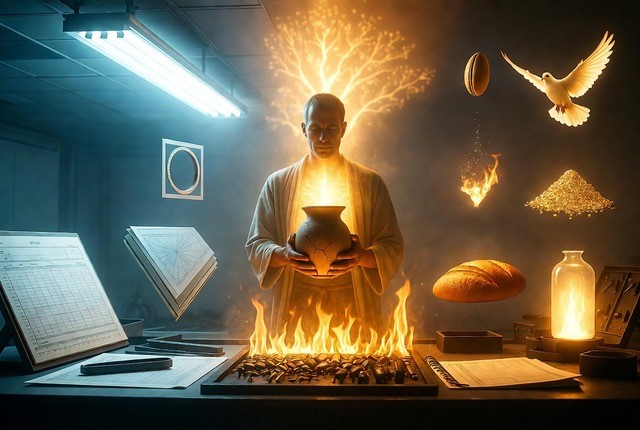








"There is no need to be worried by facetious people who try to make the Christian hope of 'Heaven' ridiculous by saying they do not want to spend eternity playing harps. The answer to such people is that if they cannot understand books written for grown-ups, they should not talk about them. All the scriptural imagery (harps, crowns, gold, etc.) is, of course, a merely symbolical attempt to express the inexpressible… People who take these symbols literally might as well think that when Christ told us to be like doves, He meant that we were to lay eggs." — C. S. Lewis, Mere Christianity
There is more than one room in your head—perhaps three. One is lit with a glare like fluorescent light: precise and efficient. It counts syllables. It balances ledgers. It reads the signs and takes them literally. The left hemisphere is the accountant of the mind, the one who needs the fine print, the one who will not be moved by beauty alone. Give it a formula, and it will give you a solution. It is literal, sequential, and analytical. It measures, categorizes, and controls. It is suspicious of anything it cannot quantify. It sees the word but not the world behind the word, the tree but not the forest, the symbol but not the reality that casts it. This is the mind that hears Jesus say, "Be like doves," and thinks, "Lay eggs." Lewis delighted in exposing that kind of wooden literalism. The left brain knows only itself and its calculations. It resists metaphor because metaphor threatens its sovereignty.
Another room is lit by something as soft as firelight. It speaks in pictures. When it hears thunder, it feels power. It sees a father running down a road toward a ragged son and, ignoring the details, feels the reunion in its chest before the prodigal has taken another step. The right hemisphere is the poet and dreamer, the one who has always known that the most important things cannot be said directly — only shown. It is the keeper of context. It sees the forest and the tree at once. It understands metaphor, symbol, story, and sacrament. Receptive, imaginative, and relational, it is the part of us that can behold beauty, perceive meaning, and recognize the eternal when it casts its shadow into the temporal. This is the mind that hears "dove" and understands innocence, "gold" and understands glory, "light" and understands holiness, "bread" and understands life. The right hemisphere is the organ of metaphor — and metaphor is one of the primary languages God chooses.
We live in a world that speaks in noise, but God speaks in metaphor. And the more I watch the human mind at work — its hemispheres, its impulses, its strange architecture—the more I see why Scripture is woven from symbol and story. The eternal casts its shadows into time, and metaphor is how those shadows can be described. Modern neuroscience, for all its complexity, still points us toward something the prophets already knew: the human mind is not a single faculty, but a conversation — and that conversation requires more than two voices.
Neither hemisphere can rule the soul alone. The left brain without the right becomes a Pharisee. The right brain without the left becomes a mystic without discipline. And so God placed a third capacity between them — the frontal lobes, the seat of self-awareness, conscience, and moral judgment. This is the referee between the hemispheres, the moderator of the inner life, the organ of wisdom. It is the place where imagination is evaluated, impulse is restrained, and moral choices are made. It is the capacity that weaves reason and imagination into a single moral agent. It is here that the image of God is most clearly exercised.
Lewis called the trained capacity that integrates them "the chest" — the seat of just sentiments, the place where imagination and reason are harmonized into virtue. He insisted that children must be taught to love the good, the true, and the beautiful — and to hate evil—because the part of us that chooses virtue does not arise from instinct alone; it is formed in the soul.
The left brain cannot love the good. The right brain cannot discipline desire. Only the integrating work of the frontal lobes can harmonize them into a human being capable of holiness.
And here — right here — is where the story of humanity rises above even the angels. Although angels are free, self-aware, and capable of loyalty to God, they remain capable of treason. Some fell; most did not. Satan did not fall from ignorant innocence. He fell because the clarity of God's very presence fueled his envy to the point of rebellion. Proximity to God does not eliminate the possibility of treason; it magnifies it.
Humanity is not God's second attempt. Humanity is God's chosen vessel for a deeper glory.
We are the race forged in the fires of time. We are the race born into the mortal coil. We are the race that knows temptation, suffering, death, forgiveness, and resurrection. We are the race that will know God in both His holiness and His mercy.
The angels know His power. We will know His heart. This is why Lewis suggests that redeemed humanity will bear a glory unfallen humanity could never have known. Not Eden restored, but Eden surpassed. Not innocence regained, but innocence transfigured. Not the old creation repaired, but a new creation born from death itself.
Innocence is beautiful — it is the morning. Redemption is radiant — it is the sunrise after a long night. Innocence is the seed and the unbroken vessel. Redemption is the tree that grew because the seed died; it is the broken vessel remade by the hands of God.
We will be stronger because we have passed through death, and wiser because we have tasted evil and chosen good. We will be holier because we have been forgiven much. We will be more radiant because we have been resurrected.
Lewis spoke of "unfallen races" as hypothetical. But we do not need hypotheticals. The angels themselves prove the point. Even the faithful angels — who never rebelled—will look upon redeemed humanity and see a glory they never knew: glory born of mercy, glory born of resurrection, glory purchased with blood.
We are the race that will be united to Christ; the race that will judge angels; the race that will be the Bride; the race that will shine with a glory innocence could never carry.
This is the mind that hears God; the soul God is remaking; the race forged in fire. And this is the greater glory yet to come.