








A Greater Glory, Forged in Fire — Part Two
Last week's musing ended with these words: "This is the mind that hears God."
That place has a name. It lives just behind your forehead. The frontal lobes. The seat of judgment, of delayed gratification, of moral reasoning. The part of the brain that says wait — before you act, before you speak, before you decide — let's bring both rooms to the table. The frontal lobes are the referee. Not the loudest voice in the room, but the one with the whistle. The one that holds the two hemispheres in tension long enough for wisdom to emerge from the friction.
When the referee is asleep — when the frontal lobes are silenced by pride or pain or the sheer relentless noise of a distracted age — the two rooms go to war. The literalist becomes a hammer looking for nails. The poet becomes untethered in fantasy. And the human being, made in the image of a God, who is both precise and beautiful, both Logos and Love, fractures into something less than he was made to be.
This architecture — literal and luminous, held in tension by the arbiter within — is the image of God stamped into your grey matter.
Now, let me take you somewhere older than neuroscience.
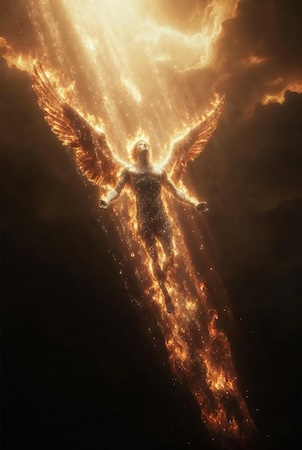
Ezekiel 28. There was a being described as the anointed guardian cherub. Covered in jeweled fire. Perfect in beauty. Blameless from the day of his creation. He walked among the stones of fire. He was not distant from the throne, not receiving dispatches from the front. He was there, in the heat and the light, in the immediate, unmediated presence of the Divine. His name was Lucifer — Son of the morning — Bearer of light.
And here is the thing that unravels every simple story we tell about that fall. He didn't fall from ignorance. He fell from certainty.
He had communed with God, face to face, without the veil of faith. He had no need of metaphor, because he stood within the reality it points to. He had no need of longing, because the object of all longing was right there, luminous and present. There was only the fire, with him inside it.
And that — that very proximity, that total unmediated clarity — became his undoing. Because certainty without humility is not wisdom, it is the seed of pride. And pride — once it takes root in a being who has seen God face to face and still chosen himself — that is the coldest, most absolute fall imaginable. Not a stumble into darkness. A step away from light, taken in full knowledge of what was being abandoned.
He fell not from the bottom of creation. He fell from the top. And the distance he fell was therefore immeasurable.
Now turn and look at us. Made from dust. Breathing borrowed air. Born into a world that offers no unmediated certainty — only clues, echoes, intimations. We do not walk among the stones of fire. We read about them. We strain toward them through a glass darkly, catching occasional refractions — a sunset, a child's laugh, a moment of inexplicable mercy — and we say, there, that is pointing to something. We were not made for clarity in this world. We were made for faith. And faith is only possible in the absence of certainty.
Lucifer's limitation was that he had no room for faith. He had seen too much. There was no journey left to take, no return to be made, no prodigal story to inhabit. He could not be found because he had never been lost. He could not be forgiven because he had never needed mercy. The fullness of his proximity had, paradoxically, closed off the most important room in the house.
But us? We were built for the journey and shaped in dust. Given a world full of signs and wonders and silence, and asked: Will you trust what you cannot yet see? Every loss that refined you. Every prayer that seemed to fall unanswered. Every morning you chose to get up and keep going anyway — that was the forge working from the outside in. And the thing that emerges from a forge is not the same as the thing that enters it.
Lucifer was blameless from the day of his creation. But you are being made blameless — and that is a different and greater thing. Because it is chosen. It is fought for. It is arrived at through the long, dark, stumbling pilgrimage of a creature who could not see the destination and walked toward it anyway.
And here is where it gets breathtaking: First Peter, chapter one, verse twelve. Peter is describing the glories of salvation — the suffering, the grace, the redemption woven through history — and he pauses to say something almost casual that we often blow past too quickly. He says: The angels long to look into these things. The angels who attended creation, who shouted for joy when the foundations of the earth were laid, who stand before the throne and cry holy, holy, holy without ceasing — those angels are straining forward, leaning over the balcony of heaven, trying to understand something they have never experienced.
What is it like to be found? Angels don't know. They have never been lost. They have never tasted the far country, never come to their senses in a pigpen and turned back toward the Father whose silhouette they could barely make out on the horizon — and then felt those arms around their shoulders helping them stumble to their feet. The angels have never known that. And so they lean in — and wonder.
And then — Paul in First Corinthians 6:3 — do you not know that we shall judge angels? Not as tyrants. Not as conquerors. But as veterans. As those who have been tested in a theater of war, that angels only witnessed from the gallery. As those who chose faithfully in the dark, who walked by something they could not yet see, who integrated the literal and the luminous under a conscience battered by the world and refined by the Spirit — and came through.
The redeemed human being carries something no angel has ever held: the memory of mercy received, the knowledge of what it cost, the gratitude that lives only in the chest of someone who was genuinely lost — and was genuinely, impossibly, tenderly found.
So here is what I want to leave with you this morning. The architecture of your soul is not a mistake. The fact that you hold two hemispheres in constant negotiation, that you must choose every morning between the accountant and the poet — that tension is not a design flaw. It is the image of God in you, asking to be integrated, not resolved.
Lucifer had no such tension. He was all clarity, all proximity, all certainty — and it destroyed him. Not because clarity is evil, but because clarity untempered by the humility of a creature who still has something to learn becomes the most dangerous force in the universe.
You are still learning and still walking. Still integrating and still choosing, day by day, to trust the One you cannot fully see.
And the angels lean in. Not because you are greater in power or wiser in knowledge, but because you have been through the fire from the outside, and you carry the marks — and the glory — of creatures who chose anyway. That is an exceeding and eternal weight of glory that Lucifer never possessed. And he knew it, which may be the truest explanation we have for why he hates us so.
If there's one takeaway from today's reflection, it's that if God's language is metaphor, then the truth revealed in Scripture is greater than the literal truth we experience every day of our lives.