








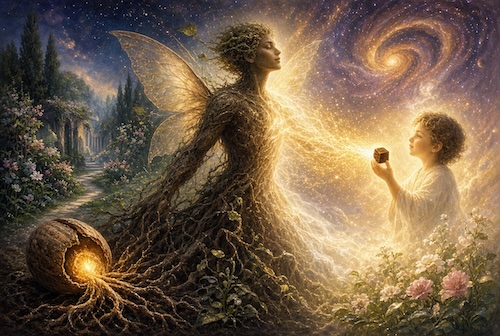
From Evolution to Transfiguration
C.S. Lewis observed that our difficulty in imagining life in the New Creation is much like a child's difficulty imagining a pleasure greater than chocolate. We know the joys and longings of our present embodied existence, including sexuality, and therefore tend to view their absence as deprivation. Yet Lewis suggests that resurrection life is not a perpetual fast but a greater feast. What seems to us a loss may ultimately prove to be a fulfillment so complete that what once occupied our worldly desires becomes unnecessary. The distinction between male and female may remain, not as biological necessity, but as part of the splendor of redeemed humanity. Thus, heavenly life is better understood not as sexless, but as transformed, transfigured, and brought to its intended fullness in God.
That insight has led me to reflect on a larger question. If God's purpose is not the abandonment of human nature but its fulfillment, might transfiguration itself be the completion of creation's long journey toward its divine destiny? And this morning I have been thinking about the relationship between evolution and the Christian hope of resurrection. While these two ideas are often set against one another, I wonder if they may be describing different parts of the same story.
The Scriptures present creation not as static, but as moving toward fulfillment. The universe begins in simplicity and unfolds into ever greater complexity. Stars are formed, worlds emerge, life appears, consciousness awakens, and eventually humanity stands within creation as a creature capable of knowing, loving, worshiping, and responding to God.
From a biological perspective, evolution describes this unfolding process. It tells us something, however imperfectly, about how life develops and diversifies. Yet Christianity asks a deeper question: What is all this development for?
The Bible teaches that humanity is uniquely created in the image of God.
"Then God said, 'Let us make mankind in our image, in our likeness.'" (Genesis 1:26)
The image of God is more than intelligence or self-awareness. It is a vocation and a destiny. Human beings are created to reflect God's character and participate in His life.
That raises an interesting possibility. Perhaps evolution is not the completion of creation but only its preparation. Humanity may represent the highest known biological expression of life on earth, yet Scripture presents us as unfinished beings. We have not yet become what God intends us to be.
The Apostle Paul writes: "For now we see through a glass, darkly; but then face to face." (1 Corinthians 13:12)
And again: "Beloved, now are we the sons of God, and it doth not yet appear what we shall be: but we know that, when he shall appear, we shall be like him; for we shall see him as he is." (1 John 3:2)
Those passages suggest that our present humanity is real but incomplete. The image is present, but its full glory remains hidden.
This is where I find the idea of transfiguration helpful. Christ's Transfiguration revealed something extraordinary. Jesus remained fully Himself, yet His glory shone through His humanity. Likewise, after the Resurrection, He was unmistakably Jesus, yet transformed. The resurrected Christ was not less human but more fully human. And perhaps that is the destiny toward which all creation is moving.
The Christian hope is not the escape of the soul from the body. Scripture consistently points toward resurrection.
"The body is the temple of the Holy Ghost." (1 Corinthians 6:19)
The body matters because creation matters. God's purpose is not to abandon His creation but to redeem and complete it. This means that body and soul belong together. Neither is fully human without the other. We are embodied souls and ensouled bodies, woven together by the creative intention of God.
For this reason, I am drawn to the thought that transfiguration is the completion of evolution. Not evolution in a strictly biological sense, as though resurrection were simply the next natural stage after Homo sapiens. Rather, evolution may describe creation becoming capable of bearing the image of God, while transfiguration describes that image reaching its intended fulfillment.
Paul hints at this future transformation: "Who shall change our vile body, that it may be fashioned like unto his glorious body." (Philippians 3:21)
And again: "For the creation waits in eager expectation for the children of God to be revealed." (Romans 8:19)
Notice that Paul does not speak only of humanity waiting for redemption. He speaks of creation itself longing for fulfillment. The destiny of humanity and the destiny of creation are mysteriously linked.
Perhaps all of creation has been moving toward this moment from the beginning. Matter became life. Life became conscious. Consciousness became capable of knowing God. And through Christ, humanity is invited into a still greater transformation.
Not annihilation, nor escape. but transfiguration.
What the caterpillar cannot imagine is flight. What a child cannot imagine is a joy greater than chocolate. And perhaps what we cannot yet imagine is what God intends for those who love Him.
As Paul reminds us: "Eye hath not seen, nor ear heard, neither have entered into the heart of man, the things which God hath prepared for them that love him." (1 Corinthians 2:9)
Perhaps our difficulty is that we keep imagining the future in terms of the present. We assume that resurrection life must simply be more of what we already know. Yet Scripture suggests something far greater. And nowhere is this clearer than in 1 Corinthians 15, Paul's great chapter on resurrection. In responding to those who struggled to understand how the dead could be raised, Paul points to the natural world itself: "That which thou sowest is not quickened, except it die." (1 Corinthians 15:36)
And again: "And that which thou sowest, thou sowest not that body that shall be..." (1 Corinthians 15:37)
A seed and a mature plant possess continuity, yet they are dramatically different in appearance and function. The seed is not discarded; it is fulfilled. This may be the closest biblical analogy to what I have been calling transfiguration.
Paul continues: "So also is the resurrection of the dead. It is sown in corruption; it is raised in incorruption: It is sown in dishonor; It is raised in glory: It is sown in weakness; it is raised in power." (1 Corinthians 15:42-43)
Notice that Paul does not describe the destruction of the body but its transformation. The very thing that is sown is what is raised, yet raised into a condition beyond decay, weakness, and death.
Then comes one of the most remarkable statements in Scripture: "It is sown a natural body; it is raised a spiritual body." (1 Corinthians 15:44)
A spiritual body is not a ghost. It is not a soul escaping matter. Rather, it is a body fully animated by the life and power of God. It is matter carried to its intended destiny.
If Genesis reveals humanity created in the image of God, and evolution describes the long biological journey that eventually produced image-bearing creatures, then resurrection reveals the ultimate goal toward which that image has always pointed.
Paul concludes: "And as we have borne the image of the earthy, we shall also bear the image of the heavenly." (1 Corinthians 15:49)
That single verse may summarize the entire story. We bear the image of Adam, the earthly man. We know weakness, mortality, limitation, and death. Yet we are destined to bear the image of Christ, the heavenly man. The first image was given in creation; the second is bestowed in transfiguration.
This is why I find myself thinking that humanity should not be understood merely by looking backward to its origins. Christian anthropology is ultimately future-oriented. We understand what a thing truly is when we understand what it is becoming.
A caterpillar is not fully understood until one has seen a butterfly. A seed is not fully understood until one has seen the flower. Humanity is not fully understood until one has seen the risen Christ.
The Christian hope is therefore not escape from the world but the completion of God's purposes for it. Evolution may explain how creation became capable of bearing God's image, but resurrection reveals what that image was always intended to become.
Creation's story begins in a garden. It ends in a New Creation. And between those two horizons stands humanity: fashioned from the dust of the earth, breathing the breath of God, and destined, by grace, for glory.