







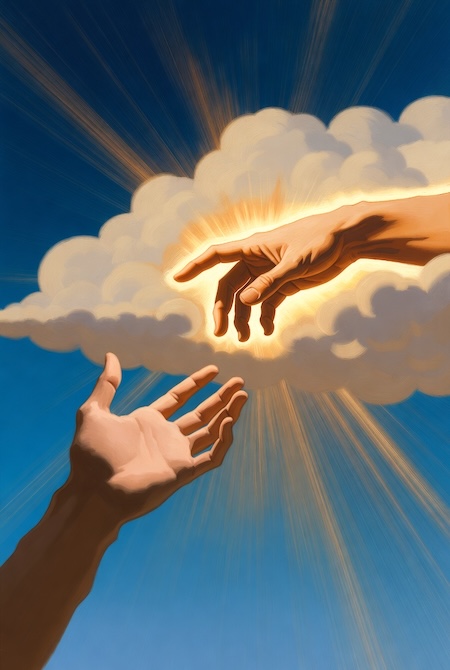
Image by Grok
The Grand Picture
C. S. Lewis once wrote to a young woman who feared that God's foreknowledge made her prayers meaningless. She imagined God as a distant observer who had "known for millions of years" what she would say. Lewis gently corrected her. God hears us now, he said, as simply and at once as a mother hears her child. The difference is that God's "now" is infinite. Our present moment slips away even as we name it, but His present does not pass. To Him, every moment is fully present. We do not pray into a void or into a timeline already sealed; we pray into the living presence of the One who is eternally here. As the psalmist says, "One day in Your courts is better than a thousand elsewhere" (Psalm 84:10). The comfort is not in understanding God's relation to time, but in knowing that when we step into prayer, we step into His presence.
This sense of divine immediacy becomes clearer when we consider our place in the universe. Existence, it seems to me, is like standing inside a vast painting. Not something we can hold at arm's length, but a mural so immense that no figure within it can ever step back far enough to see the whole. We are the creatures inside the scene—changing, choosing, stumbling, rising—never able to see what the entire picture means. We feel the texture of the paint beneath our feet. We walk through colors still being laid down. We live inside the unfolding.
But the Creator is not confined to the frame. He stands outside the canvas. He sees the first brushstroke and the last, the shadows and the light, the places where the colors clash and the places where they finally reconcile. He beholds the completed work. "Before a word is on my tongue, behold, O Lord, You know it altogether" (Psalm 139:4). We see only the tiny bit of canvas in front of us, which quickly becomes a fading memory behind us; He sees the entire masterpiece.
This is why prayer matters. When we pray, we are not like a Deist trying to attract the attention of an Artist who painted us long ago and wandered off. We are speaking to the One who is present in every moment of the picture—present in our beginning, present in our ending, present in the stroke we are living right now. Our "now" is a flicker; His "now" is the whole. Prayer is not the attempt to change God's mind but the act of aligning our small brushstroke with the hand that holds the brush. "For with You is the fountain of life; in Your light we see light" (Psalm 36:9).
Lewis also insisted that evolution and the Fall do not contradict each other. Evolution describes biological change—sometimes for the better, sometimes for the worse. The Fall describes a moral collapse, the moment when the child loses its innocence or the adult turns away from the moral height for which they were made. One is about bodies; the other is about souls. Evolution tells us how the paint has changed; the Fall tells us how the figures inside the painting turned their faces away from the Painter. "All we like sheep have gone astray; we have turned—everyone—to his own way" (Isaiah 53:6). These are not competing explanations but different layers of the same canvas.
And perhaps this helps explain why life feels, at its core, like a tragic comedy—because everything breaks and decays and we are surprised that "the best laid plans of mice and men often go awry." We live in a world where sorrow and absurdity walk hand in hand, and the only antidotes are empathy and a sense of humor—qualities we share with the One who made us. God must have both in infinite measure, or else He could never love creatures such as we. "He remembers that we are dust" (Psalm 103:14); that is divine empathy. "He who sits in the heavens laughs" (Psalm 2:4); that is divine humor—not mockery, but perspective.
And then there is Jesus, the Incarnation of God Himself, standing at the tomb of His friend, weeping with those who weep, and moments later calling a dead man out of the grave. "Jesus wept" (John 11:35). Yet "for the joy set before Him, He endured the cross" (Hebrews 12:2). Only a God who knows both sorrow and laughter could hold a world like ours. Only a God who carries both grief and joy could carry us. Our laughter and our tears are not accidents of biology; they are reminders—quiet, persistent reminders—that our Spirits come from somewhere else.
In the end, the comfort is simple. We do not have to understand the whole painting to trust the Painter. We do not have to see the end to walk faithfully in the middle. We do not have to solve the mystery of time to know that God hears us now. We are living strokes in His hand, part of a story He already sees as a whole. When we pray, we speak to the One who stands outside the frame and yet meets us inside it with mercy, attention, and love. "I am the Alpha and the Omega, the beginning and the end" (Revelation 22:13). One day, perhaps, He will lift us out of the painting and let us see the whole. But for now, take comfort in the knowledge that He is always with us on this vast canvas we call the universe.