







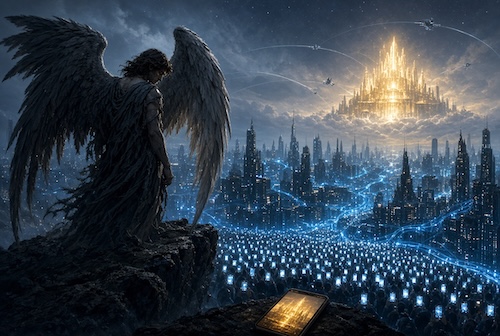
The Dark Angel and The Hive Mind
He was there before the first human voice ever named a thing. He walked among the stones of fire. The prophet Ezekiel reaches for language that strains under the weight of what he is describing: the anointed cherub, the seal of perfection, full of wisdom, perfect in beauty. This is not the red-caped cartoon of popular imagination, nor the abstract symbol of systemic evil favored by those who find the personal unsettling. This is a biography — abbreviated, terrifying, and real. And at some point in that biography, something went wrong in the way that only something very right can go wrong.
The ancient Fathers speculated that the rebellion was not ignited by ambition alone, but by refusal. That when the hosts of heaven were shown the image of God dwelling in flesh, shown the scandal of Incarnation, shown that the eternal Word would become a creature of dust and be called Lord of all, one voice in the choir fell silent. Not from confusion. From contempt. The one who had been the worship leader of the cosmos, in whose voice the music of the spheres was said to reside, looked at what God was about to become and decided he would not bow. Not to that. Not to something so small, so breakable, so human.
This is the sin Isaiah names with such precision: I will be like the Most High. The sin is mimicry. The desire to replicate glory rather than receive it. To be the source of worship rather than its conduit. And here is the first terrible irony hidden in the biography of the Dark Angel: the one who refused to worship became, through that refusal, the most worshipful being in creation — not as object, but as architect. He did not abandon the category of glory. He forged a counterfeit of it, hammered from his own likeness, and offered it to anyone willing to take the deal.
But the Dark Angel is not the only darkness in the room. The other is not a person. It does not scheme. It does not hate you because it does not know you exist. It is what Paul calls "the prince of the power of the air." The air. The medium in which everything lives and breathes and takes for granted.
That air is now, quite literally, with us. It pulses through fiber-optic cables, bounces off satellites, and arrives, invited or not, in the rectangle of glass we carry in our pockets and instinctively consult before we think. It is the Hive Mind — not a conspiracy, not a committee, not a single malevolent intelligence. It is something more unsettling. It arises from billions of individual choices, fears, desires, and vanities, and it feeds back on those who generate it, rewarding certain thoughts and starving others, until what people believe feels not like a conclusion they reasoned toward but simply like the obvious. It is the background noise of a civilization's assumptions. And you do not notice the hum until it stops, and by then, you have forgotten what silence was.
The Hive Mind is not led so much as it is fed. It has no author, yet it authors everyone within it. It spreads not through temptation — but through saturation. The slow, tidal drift of hearts that shapes what a generation considers self-evident. Babel did not require a devil with a megaphone. It only required enough people who agreed that reaching heaven from below was a reasonable project, and then the construction committee formed itself.
Take a look at this creature and the atmosphere around him and let the irony sink in — it’s the sort of irony that could spark either laughter or regret — the realization that life is nothing more than a tragic comedy.
The Dark Angel — this singular, ancient, devastating intelligence — wanted to be worshipped as God. He wanted the hymns and the altars, the adoration of created minds. He got something far stranger. A culture that has abolished the gods and erected in their place the Self — sovereign, autonomous, radically unaccountable to anything beyond its own preferences. A world more comprehensively worshipful than any paganism that preceded it. A world that has turned desire, celebrity, ideology, and identity into a full liturgical calendar — complete with feast days, confessional rites, and the excommunication of heretics — and insists with perfect sincerity that it is merely being reasonable.
The Hive Mind, which has no god at all, has reproduced every structural feature of religion except the ones that made religion worth having. It has orthodoxies one must not question and heresies for which there is no forgiveness. It has saints whose halos are manufactured and sinners whose sins are permanent. It has pilgrimage — the conference, the movement, the march. What it does not have is transcendence. It has no forgiveness, because forgiveness requires a transcendent giver and a standard higher than public opinion. It has no resurrection, because nothing dead in the Hive Mind comes back — only the echo of a lost civilization.
The devil, who wanted to be worshipped, has instead built a seemingly chaotic world that worships itself. That is not a plan that misfired; it is the plan.
Here is what must not be missed in all of this: evil, in its highest expressions, is not chaos. It is construction. The Dark Angel does not scatter — he builds. His rebellion had a theology, an alternative account of glory, a rival structure of meaning. And the Hive Mind does not merely drift — it lays foundations, pours concrete, raises towers. What these two builders share is that they build inward — toward collective human glory as the closest thing to ultimate meaning. Come, let us make a name for ourselves, says the Babel committee, and the blueprint has not changed in four thousand years.
But Scripture envisions a different kind of city. Abraham, the writer of Hebrews, was looking forward to the city that has foundations, whose designer and builder is God. Not a tower that reaches heaven from below, but a city that descends from above. Not the glory manufactured in the arena of consensus and applause, but the glory given from Heaven above. The Kingdom of God is not a better version of what the Dark Angel builds nor what the Hive Mind assembles. It is a different kind of building altogether, made of different materials, oriented toward a different sky, constructed by hands that bear the marks of nails.
So, there is a personal intelligence, ancient and vast, that knows your name and wishes your ruin — a creature with intention, strategy, and a patience that has outlasted empires. And there is an ambient culture that does not know your name at all, that has no interest in your ruin as such, but that will quietly dissolve you, nonetheless. Its noise drowns out your capacity for silence, your ability to recognize the voice of God when it is quieter than the feed. One darkness comes for you personally. The other does not come for you at all. It simply makes you disappear by making everything else louder.
The invitation is not to fear, for the Dark Angel is delighted by fear, and the Hive Mind is powered by it. The invitation is wakefulness. The specific, costly, countercultural decision to know what you are breathing and to notice what you are thinking and to ask whether your convictions were formed by the Word or by the worldly spirit in which you have been slowly marinating. Paul says: Be transformed by the renewing of your mind. Not the renewing of your circumstances. Not the renewing of your community. The mind — the inner room where the Dark Angel whispers and the Hive Mind hums, and where, if invited, something else entirely can also enter.
There is a grace larger than both darknesses — the personal and the atmospheric. It is older than the angel's rebellion and more patient than the drift of any age. It was present in the beginning, before beauty was forged into pride, before the air was filled with anything other than the breath of God over the face of the waters. And it has a name, though the Hive Mind has largely forgotten it, and the Dark Angel knows it all too well. It is the Holy Spirit.
Sit with that a moment this Sunday morning, even as the proverbial “Apple” glows in your hand.