







The Question Beneath All Questions
There is a question that has built civilizations, launched ships across unknown oceans, filled libraries, raised cathedrals, and kept countless souls awake long after midnight. It is not what. It is not where. It is not even how. It is why. Children ask it instinctively. Before they learn caution, before they learn sophistication, before they learn the art of pretending to know, they ask: "Why?"
Why is the sky blue? Why do people die? Why is this wrong? Why am I here? Why does anything exist at all?
Somewhere along the road to adulthood, many of us stop asking. Not because the questions have been answered, but because they have become inconvenient. We learn how things work and mistake that knowledge for understanding why they exist.
Science can tell us how an eye functions. It can describe the rods and cones, the optic nerve, and the remarkable processes that translate light into sight. It can even propose how eyes developed through natural selection. But another question remains patiently waiting: Why should there be light at all? And if there were no light, why would there be eyes?
The eye exists because it is fitted for something beyond itself. Likewise, the mind seems fitted for truth. The conscience seems fitted for justice. The heart seems fitted for love. And the soul, restless and searching, seems fitted for meaning.
C.S. Lewis once wrote: "I believe in Christianity as I believe that the Sun has risen: not only because I see it, but because by it I see everything else."
That sentence has lingered with me for years. If the sun never rose, the world would be a very dark and cold place indeed. Mountains would remain mountains. Oceans would remain oceans. Yet without light we would wander among them blind.
The Christian claim is not merely that Christ is something to be observed, admired, or analyzed. The claim is that He is the light by which everything else becomes intelligible — not only because we see Him, but because by Him we see everything else.
If He is the light that makes all other things visible, then the refusal to choose between competing lights is itself a form of darkness. That is what Elijah confronted on Mount Carmel. Two altars, two sacrifices, but no fire. Elijah's challenge: "The god who answers by fire, he is God."
The prophets of Baal shouted from morning until evening. They danced. They pleaded. They cut themselves. They repeated the same rituals, hoping for a different result.
Elijah stood apart and asked, with devastating irony, "Perhaps your god is asleep."
The joke was about exposure. He was revealing the contradiction everyone could already see. The people had become accustomed to living between two realities. They claimed one thing but trusted another. They were limping between competing loyalties, trying to stand with one foot on truth and the other on convenience.
Finally, Elijah rebuilt the broken altar of the Lord, offered a simple prayer, and fire fell from heaven. Many people focus on the fire. But the deeper miracle is what Elijah does before the fire falls. He repairs the broken altar of the Lord — an altar built of twelve stones, representing the twelve tribes.
Elijah's challenge was not fundamentally about fire. It was about clarity between two incompatible worldviews. "How long will you live with the contradiction?"
Every age has its Baals. Not carved idols, perhaps. But money, power, status, ideology, comfort, self-sufficiency, and the endless temptation to trust what cannot ultimately save. And every age discovers the same thing. The louder shouting does not produce an answer. Reality remains reality. Yet there is a mercy hidden in every disappointment.
Cognitive dissonance is painful because it forces a choice. The story we are telling ourselves collides with the world as it actually is. And at that crossroads, a question rises again: Why?
Why does truth matter? Why do we long for justice? Why does beauty move us to tears? Why do we seek clarity? Why do we hunger for meaning? If there is no truth, why seek it? If there is no meaning, why mourn its absence? If there is no light, why do our eyes search for dawn? Maybe the deepest evidence is not that we have found all the answers. Perhaps it is that we cannot stop asking the questions.
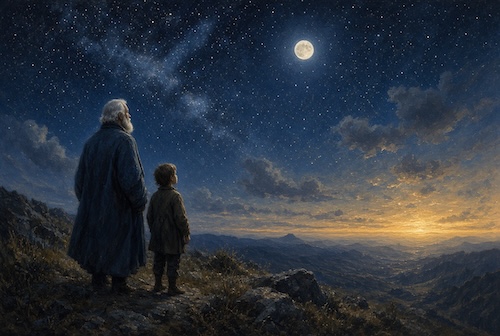
The atheist and the believer may disagree about the destination, but both stand beneath the same stars asking why they are there. That shared longing is a mystery in itself. And perhaps a clue. For it may be that the most important word ever spoken is not an answer at all. It is a question — one that echoes through philosophy, science, poetry, theology, and every human heart. A question that has outlived empires and will likely outlive us all. A question that simply asks: why?
Perhaps the reason we continue asking is because we were made not merely to survive in the world, but to understand it. Not merely to walk beneath the light, but to seek its Source. And in finding its Source, we learn that the light was never meant to end with us, but to pass through us in love of God and neighbor.
For Jesus said: "You shall love the Lord your God with all your heart, with all your soul, with all your mind, and with all your strength." This is the first commandment. And the second is this: "You shall love your neighbor as yourself." There is no other commandment greater than these.