







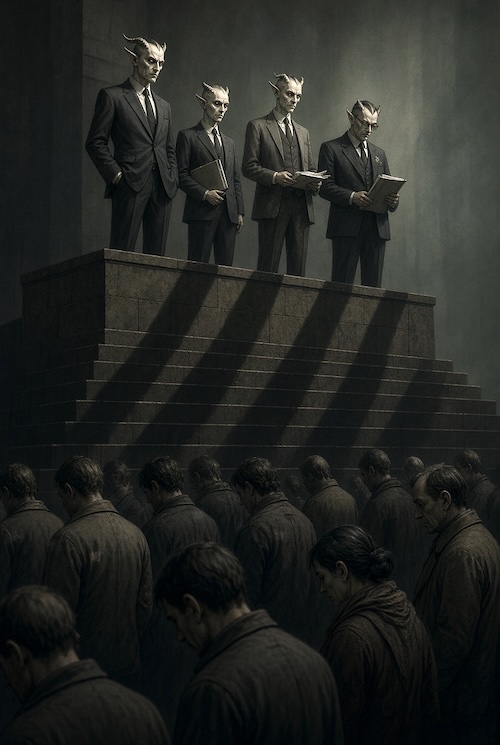
The Sneaking Shadow
In the quiet hours before dawn, when the community outside my window begins to stir, I find myself thinking about the strange irony of human endurance. We praise perseverance as if it were always a virtue, but the old stories warn us that perseverance can become a trap.
The Declaration of Independence says it plainly and with the weight of experience: "Prudence, indeed, will dictate that Governments long established should not be changed for light and transient causes; and accordingly all experience hath shewn, that mankind are more disposed to suffer, while evils are sufferable, than to right themselves by abolishing the forms to which they are accustomed." Jefferson wasn't condemning mankind. He was describing human nature. We endure too long. We tolerate too much. We grow accustomed to the slow creep of injustice until it becomes just another part of the landscape we live in.
Lone Watie, in "The Outlaw Josey Wales," put it in frontier terms: "I'm an Indian, all right; but here in the nation they call us the civilized tribe. They call us 'civilized' because we're easy to sneak up on. White men have been sneaking up on us for years." The old Chief was describing the thousand small steps of treaties, promises, encroachments, and delays that slowly erode freedom. The gentle but slippery slope that ends at the bottom of a cliff.
C.S. Lewis understood that slow, dangerous slope all too well, which is why he often likened government bureaucracy to Hell. In his short novel "The Screwtape Letters," one letter from the head demon, Screwtape, to his subordinate tempter, Wormwood, reveals his favorite weapon isn't violence, but gradualism. Not the cliff, but the gentle incline. Not the crisis, but the steady drift. A soul doesn't need to be broken — just worn down until every choice feels pointless. "Damned if you do, damned if you don't." The paralysis of someone who has pushed on long past the point of hope.
And then there is John Prather — I wrote about him in a previous musing. The old rancher who stood on his New Mexico ranch with a rifle and a mule, facing down the machinery of eminent domain. He endured fifty years of storms, droughts, loneliness, and government pressure. But when the Army told him to leave his home, endurance became defiance. Perseverance became a line in the sand. He didn't declare war. He simply refused to move. In the end, the Army buried him on the land he defended — because even they recognized that some forms of perseverance are not stubbornness but righteousness.
The chiefs in Josey Wales understood that too. When the bureaucrats, after listening to their lists of grievances and stories of betrayal, told them to "endeavor to persevere," they went home, thought about it, and declared war on the Union. Not out of bloodlust, but out of clarity. They realized that perseverance had become a leash.
There comes a moment when suffering "while evils are sufferable" is no longer noble — it is dangerous. A moment when the gentle slope becomes a cliff. A moment when the sneaking shadow of corruption completely overshadows the light of liberty. A moment when perseverance must give way to courage. The irony is that the very virtue we celebrate — endurance — can become the mechanism of our undoing when it is detached from justice, truth, and hope.
John Prather knew the difference. Jefferson warned us about it. Lone Watie saw it coming. Screwtape exploits it. Maybe that's the quiet lesson for this morning: Persevere in what is good. Resist what is evil. And when the slope grows too steep, stand your ground.