







 The Wrong War
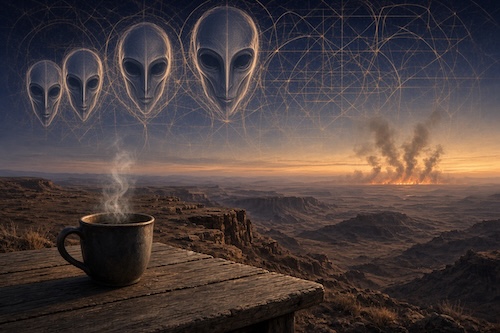
My coffee is still hot. The morning is still quiet. And somewhere over the ancient lands of the Middle East, something is burning that the headlines cannot fully explain.
I have been sitting with a sentence this morning. Not a scripture — though one will come — but a sentence from H.G. Wells, written in 1898, that feels less like science fiction and more like prophecy with each passing year: "Yet across the gulf of space, minds that are to our minds as ours are to those of the beasts that perish, intellects vast and cool and unsympathetic, regarded this earth with envious eyes, and slowly and surely drew their plans against us."
Wells meant it as horror. I read it now as prophetic diagnostics. Not because I believe in Martians. But because Wells, in trying to imagine something above us looking down at us, accidentally described the precise spiritual geometry of our moment. There are ancient and purposeful intelligences influencing this Islamic theater of human conflict with something far colder than hatred. What I see in the spiritual architecture of these wars is something closer to management; a cultivated chaos, a tended fire. And we — distracted humanity — keep arguing about the fire.
And perhaps that is why all of this feels strangely familiar. In recent years I have found myself returning, again and again, to the same constellation of figures — Prometheus, Shelley, Rand, Wells, Lewis — not because they share a genre, but because they share a warning. They are the storytellers the West has always summoned when it needs to remember what fire means. And now, almost on cue, they are reappearing across our cultural landscape, invoked by writers and thinkers who do not know each other and do not share a theology, yet somehow reach for the same myths. That is the uncanny part — the sense that the old stories are resurfacing on their own, as if the moment itself is calling them back. Prometheus gave man fire; the West spent millennia arguing about what man should do with it. The fire was never the civilization. The argument was. And when the argument falters, the fire begins to speak again.
C.S. Lewis understood this. In The Screwtape Letters, the senior demon's most reliable weapon is not temptation toward obvious evil. It is misdirection — keeping the patient focused on the visible irritant so the invisible infection goes unnoticed. Lewis pressed this further in his nonfiction: He warned, with characteristic British understatement, that we are dangerously naïve if we believe the wars we can see are the wars that matter most. The real war, he insisted, precedes our history, exceeds our geography, and will outlast every peace treaty ever signed in any capital.
St. Paul wrote, "We wrestle not against flesh and blood." Paul, who knew Roman soldiers, who had stood before governors and kings, had no romantic illusions about the brutality of human power. Yet he said, not flesh and blood, but principalities — spiritual wickedness in high places. And when Paul said high places, he meant the temples of pagan gods. Today they are the high places of influence, ideology, and the invisible agreements nations make with ancient spirits they no longer have a name for.
And now, this brings me to Iran. Not the Iranian people — a people of extraordinary antiquity and culture and longing, who have suffered as surely as they have been used. But Iran the terrorist state. Iran as the place where history clashes: Persia and Israel. Islamic radicalism and Zionist theology. The revolutionary state and the ancient covenant.
What troubles me is not only the missiles but how expected it all feels to those watching the spiritual architecture. The Book of Daniel, written from within the Persian empire, speaks of a "prince of Persia" — not a human prince, but a dark angelic power, a being of governance over a region, who wars with heaven's messengers for weeks before the message gets through. This is not metaphor dressed up as history. This is the Bible's matter‑of‑fact description of the spiritual warfare behind what we call geopolitics.
The ancient writers were not primitive. They were perceptive. They saw the shadow cast by things we have since learned to call by other names: national interest, strategic doctrine, regional hegemony. They called it what it was: contested spiritual dominion over human populations. What has changed is not the reality. What has changed is our willingness to see it.
The prophets saw kings as chess pieces moved by hands the kings themselves could not perceive. And as I sit here on a Sunday morning watching the sun come up over the mesa, I feel the familiar weight of it — the sense that we are, again, in one of those hinge moments. Not the end, perhaps. But a hinge. A place where the door can swing either direction, and the choice is ours. Because that is the other thing Lewis knew, and Wells missed entirely: the vast and cool intellects are not unopposed. There is another Intelligence — not unsympathetic but agonizingly invested. Not distant, but near. Not drawing plans against us but drawing us toward something sacred and unfinished.
"The Lord has established his throne in the heavens, and his kingdom rules over all." (Psalm 103:19)
Here is my take: I refuse to mistake the visible war for the real one. I refuse to let the vastness of what I cannot control become an excuse for withholding the little I can offer — a prayer, a word, a clarity of sight, a refusal to be managed by the fear that managed conflict is designed to produce. I will pray for the people of Iran. For the people of Israel. For the people caught between their leaders and their longings. For the principalities to find their match in principalities greater still. For the hinge to swing toward mercy. And last but not least, I pray for America to reclaim her role in history as one nation under God, with liberty and justice for all.
In the end, America might be the last great hope for humanity's future. But it will not happen if we do not stand firm against the dark forces of the past.
"For the vision is yet for an appointed time; it hastens toward the goal and it will not fail. Though it tarries, wait for it; for it will certainly come, it will not delay." — Habakkuk 2:3