







As Independent Media & Congress investigates ActBlue's handling of questionable political contributions, New Mexicans deserve to know who is financing Deb Haaland's campaign for governor.
Deb Haaland's campaign has become a small-donor fundraising juggernaut. As of September 2026, her campaign reported raising $17.3 million through more than 446,600 contributions. During its latest reporting period, the average online contribution was just $21.78, and more than 96% of online donations were under $100.
Those are impressive numbers. But they also raise an important question: Are these contributions coming from hundreds of thousands of legitimate donors, or could the same problems independent journalists and congressional investigators have identified at ActBlue be happening in New Mexico? Before dismissing that question, consider what independent journalists and congressional investigators have uncovered.
Independent Journalists Begin Asking Questions

James O'Keefe — O'Keefe Media Group
In March 2023, investigative journalist James O'Keefe began examining unusually frequent political contributions processed through ActBlue and attributed to elderly donors. His investigation focused on individuals whose names appeared in hundreds or thousands of small-dollar transactions, sometimes totaling tens of thousands of dollars. Several individuals interviewed disputed making the contributions attributed to them.
O'Keefe raised a troubling possibility: Could political contributions be made using legitimate individuals' names without their knowledge or authorization? His reporting drew considerable attention, though subsequent independent reviews found discrepancies in some transaction counts. The allegations therefore require investigation.
Reference: O'Keefe Media Group, ActBlue Exposed: Texas Donors Shocked by Unauthorized Donations, AG's Office Investigating.
Charlie LeDuff — Michigan Investigative Journalist
In July 2026, journalist Charlie LeDuff investigated contributions attributed to Elizabeth Waffle, an 88-year-old Michigan widow. Federal Election Commission records reportedly attributed approximately 14,696 contributions totaling more than $150,000 to Waffle over five years. That works out to be about eight contributions a day over five years. When LeDuff discussed the records with Elizabeth Waffle, she denied contributing anything close to that amount.
Waffle acknowledged making some political donations, but the reported total was far beyond what she said she could afford. LeDuff's investigation matters because he did more than identify unusual contribution patterns. He interviewed the person whose name appeared in the records. That does not establish who authorized every transaction, but it raises a question that deserves an answer.
Reference: Charlie LeDuff, Michigan Enjoyer, July 22, 2026; The Washington Times, July 17, 2026.
Dominic Rapini — Connecticut Investigation
In June 2025, cybersecurity professional Dominic Rapini reportedly identified approximately $2 million in ActBlue contributions attributed to just 18 Connecticut residents, many of them elderly or retired. According to the investigation, five individuals signed affidavits disputing the donation histories attributed to them. If accurate, those allegations warrant investigation. An affidavit is sworn testimony, but it does not independently establish that every disputed contribution was fraudulent.
Reference: Inside Investigator, June 1, 2025, "Acting Blue: Evidence of Fraudulent Political Donations Targeting Retirees."
Congress Investigates ActBlue
Three congressional committees joined the investigation:
- House Administration Committee — Chairman Bryan Steil
- House Judiciary Committee — Chairman Jim Jordan
- House Oversight and Government Reform Committee — Chairman James Comer
Their investigation examines whether ActBlue's fundraising platform allowed prohibited foreign contributions, whether its fraud-prevention safeguards were adequate, and whether it knowingly accepted suspicious contributions. The committees have issued three interim reports that raised several troubling questions.
Foreign contributions: Congressional investigators reported that ActBlue detected 237 donations involving foreign IP addresses and domestic prepaid cards during a 30-day period in September and October 2024.
A foreign IP address does not establish that a contribution was illegal. American citizens living overseas can legally contribute to American political campaigns. But foreign transactions involving prepaid cards are certainly worth examining.
Fraud campaigns: A 2025 presidential memorandum reported that ActBlue had identified at least 22 significant fraud campaigns, nearly half involving some foreign connection.
Passport verification: The third congressional interim report, released in September 2026, alleged that ActBlue's system could accept a passport number based on its character length without independently verifying that it belonged to a legitimate U.S. passport.
Internal instructions: Congressional investigators also reported that ActBlue employees were encouraged to give questionable donors the benefit of the doubt, even when transactions presented warning signs.
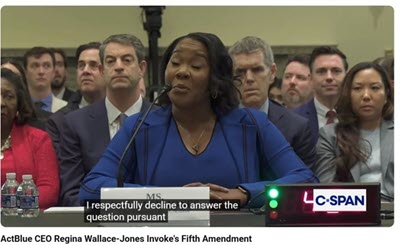
ActBlue's senior staff testimony raises more questions: During the congressional hearing, five current and former ActBlue employees invoked their Fifth Amendment rights a combined 146 times during congressional depositions, according to the committee's April 2026 report. ActBlue CEO Regina Wallace-Jones also invoked the Fifth Amendment repeatedly during a June 10, 2026, congressional hearing. The questions addressed foreign contributions, fraudulent donor identities, ActBlue's fraud-prevention procedures, and representations made to Congress.
Invoking the Fifth Amendment is a constitutional right, not an admission of guilt. But repeated refusals to answer questions leave important issues unresolved.
Where Are New Mexico's Elected Officials?
Congresswoman Melanie Stansbury serves on the House Oversight and Government Reform Committee, one of the three committees investigating ActBlue. Stansbury has been outspoken about the importance of congressional investigations, including the investigation of Jeffrey Epstein's sexual abuse and the handling of related government records. Yet she was not listed among those attending the June 10 ActBlue hearing.
And what about New Mexico Attorney General Raúl Torrez and Secretary of State Maggie Toulouse Oliver? Have their offices examined unusual ActBlue contribution patterns? Have they received complaints about unauthorized contributions? Have they communicated with federal investigators? Neither office appears to have opened an ActBlue investigation.
But these questions deserve direct answers, especially given the enormous volume of small-dollar contributions reported by Haaland's gubernatorial campaign.
How Much Has Haaland Paid ActBlue?
This is where the investigation becomes particularly interesting. Two published reports identify substantially different amounts associated with ActBlue.
Piñon Post — $91,128.1: The Piñon Post examined Haaland's campaign-finance report and identified 14 payments to ActBlue Technical Services totaling $91,128.11 during a reporting period ending in September 2026. If every dollar represented processing fees at 3.95%, the corresponding contributions would total approximately $2.31 million.
Transparency USA — $423,109.85: Transparency USA's cumulative expenditure summary identifies $423,109.85 in payments by Haaland's campaign to ActBlue New Mexico. If every dollar represented processing fees at the same 3.95% rate, the corresponding contributions would total approximately $10.71 million.
That is a substantial difference. However, one important qualification remains: the two reports identify different ActBlue entities and cover different reporting scopes. The $91,128.11 may be part of a broader total, or the amounts may represent different transaction categories. Furthermore, we have not independently established that the $423,109.85 represents processing fees alone.
The real question is whether New Mexico's campaign-finance records can reconcile these payments with the individual contributions ActBlue processed for Haaland.
My Thoughts: Follow the Money
A political campaign receiving thousands of small-dollar contributions is not inherently suspicious. There is also nothing inherently suspicious about using ActBlue to process them.
But when independent journalists uncover disputed donation histories, congressional investigators identify weaknesses in fraud-prevention procedures, and senior ActBlue officials repeatedly invoke their Fifth Amendment rights, the public has legitimate reasons to demand greater transparency.
Haaland's campaign has reported extraordinarily small-donor fundraising numbers. The campaign should be able to substantiate those numbers with accurate contribution records, including lawful donors' identities, the dates and amounts of their contributions, refunds, and the processing fees paid.
The Piñon Post's $ 91,128.11 and Transparency USA's $423,109.85 should be reconciled, not treated as proof of wrongdoing. If the larger amount consists entirely of processing fees, the implied volume of contributions would be approximately $10.71 million. That would make an examination of the underlying transaction records especially worthwhile.
But even $10.71 million in legitimate contributions would not constitute a scandal. The issue is whether any contributions were made without donor authorization, through prohibited foreign sources, or using another person's identity.
I want to know whether the donors are real, whether they authorized the contributions attributed to them, and whether the money came from lawful sources.
A legitimate fundraising operation should not find those questions difficult to answer through appropriate audits and investigations. New Mexico Attorney General Raúl Torrez, Secretary of State Maggie Toulouse Oliver, and Congresswoman Melanie Stansbury should be asked what steps, if any, they have taken to examine these issues. If investigators uncover evidence of unlawful contributions, they should refer the findings to the appropriate enforcement authorities, regardless of which political party or candidate benefited.
The question is no longer simply how much money Deb Haaland has raised. It is whether the public can independently verify the extraordinarily small-donor fundraising story her campaign is telling.
New Mexicans deserve to have that question answered before Election Day.