







A Path Forward for New Mexico's Republicans
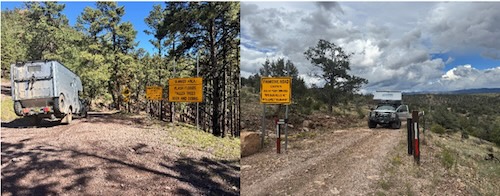 If NM Republicans want an easy path, be a Democrat. Photo by Mick Rich
Haaland presents both challenges and opportunities
The electoral challenge is straightforward. Haaland received more votes in the Democratic primary than all votes cast in the Republican primary combined. Independent voters also favored Democratic candidates by roughly a two-to-one margin. Republicans face a significant uphill battle heading into November.
At the same time, Haaland carries political baggage. During her tenure at the Department of the Interior, she prioritized her pueblos' interests over the Navajo Nation in a sovereignty dispute. Questions have already arisen regarding financial enrichment while failing to her Pueblo's attempt to open a casino in New Orleans. Let us not forget she was silent when her daughter's extreme Pueblo rights organization occupied a portion of the Department of the Interior headquarters in Washington.
Hull, Rodriguez, and Turner
The three candidates brought a great deal to the Republican Party of New Mexico. The three candidates have been quiet on the Republican scene for over a decade, suggesting that candidates and voters are open to considering Republicans once again. The three candidates are seen as coming out of the three major factions of the Republican Party but did not behave as if they were in separate factions.
If the RPNM has any hope of bringing Republicans together, the three should be invited to head a committee to rewrite the Republican Party of New Mexico's platform.
The RPNM once again embarrassed New Mexico's Republicans
I was not surprised by the statement released by the Republican Party of New Mexico:
"If it wasn't clear before, it is now: Republicans are going to flip New Mexico red in 154 days," said Interim Chairman Mike Nelson. "Republicans all across our great state are ready to unite, organize, and work together until the general election in November."
The statement reminds me of the confidence often attributed to General George Armstrong Custer before the Battle of Little Bighorn. Confidence alone is not a strategy. History demonstrates that believing victory is inevitable can be a dangerous substitute for honest self-assessment.
The Republican Party of New Mexico has suffered through multiple disappointing election cycles. Repeating the same strategies while expecting different results is not a formula for success.
It is my understanding that the current interim leadership continues to follow the Pearce-Barela playbook: holding State Central Committee meetings in the far southeastern corner of the state, while charging substantial attendance fees. Whether intentional or not, such decisions make participation more difficult for Republicans from Albuquerque and central New Mexico while benefiting factions located closer to the meeting site.
This faction-first approach helped create a divided party. The result was a splintered organization, the resignation of former Chairwoman Amy Barela, and continued electoral setbacks.
RPNM at the edge of the precipice
Amy Barela may have served as chairwoman, but no political organization drifts this far off course because of a single individual.
The interim chair of the RPNM issues a statement that ignores reality, placates the rank and file in an attempt to retain power. The RPNM Executive Director has publicly acknowledged the party's division but does not provide a solution to bring Republicans together. The RPNM interim Chair has called for an RPNM SCC meeting to elect a new Chairman, but his methods only stoke the fire of division among New Mexico's Republicans.
In one more election cycle like the past decades, the RPNM will be ranked behind Democrats and Independents.
The gubernatorial ticket provides a unique opportunity.
Mayor Gregg Hull brings the perspective of Rio Rancho and New Mexico's growing technology and business corridor. Lt. Governor nominee Michael Gallegos brings the perspective of southeastern New Mexico and the state's energy-producing region. Together, they represent different geographic, economic, and political constituencies within the Republican coalition.
Their leadership can help unite Republicans who have spent too many years divided by factional disputes.
Candidates seeking leadership positions within the Republican Party should demonstrate their commitment to that unity and work closely with the statewide ticket rather than pursuing internal power struggles.
A New Political Center
It may also be time for the Republican Party to reconsider where it places its organizational center.
Albuquerque remains New Mexico's largest city, but it has increasingly become associated with many of the state's challenges, including crime, declining public confidence in government, and economic stagnation.
Rio Rancho and Sandoval County offer a different model. Over the past decade, Rio Rancho has transformed itself from a community often dismissed by critics into one of New Mexico's most successful cities. It has experienced population growth, economic development, and improvements in quality of life that many communities would like to replicate.
The Republican Party should consider relocating its headquarters to Sandoval County and holding its next State Central Committee meeting in Rio Rancho.
Rio Rancho may be separated from Albuquerque by only a river, but politically, economically, and culturally, they represent very different visions of New Mexico's future.
Let Republicans from across the state see firsthand what a Republican-led city looks like.
Learning From the Candidates
The next State Central Committee meeting should begin with presentations from Gregg Hull, Doug Turner, and Duke Rodriguez.
Party members should hear directly from the candidates: Why are they Republicans? Why did they seek to become New Mexico's next governor? What reforms do they believe New Mexico needs most? What lessons did they learn during the primary campaign?
Such conversations would do more to unite Republicans than another round of procedural battles and factional maneuvering.
A Different Direction
Republicans can win in November, but doing so requires a willingness to break from the habits that have contributed to years of disappointment.
The party must become more welcoming, more inclusive of differing viewpoints, and more focused on winning elections than winning internal disputes.
My own experience as the Republican nominee for the United States Senate demonstrated what candidates experience when they are not part of one faction or not part of any faction. At my first meeting with the RPNM executive director to discuss my candidacy, I was met outside and told we would meet at the nearby Starbucks. RPNM leadership attempted to persuade me to withdraw after I had already secured a place on the November ballot. A few respected Republican business and agricultural leaders, who pledged financially supporting my campaign, no longer answered my calls. The first contributions from the oil and gas industry came from a Democrat.
No Republican candidate should have to navigate the minefield of the fractured RPNM.
The Republican Party of New Mexico stands at a crossroads. It can continue down the path that has produced division and electoral defeat, or it can chart a new course focused on unity, growth, and statewide competitiveness.
The choice belongs to the State Central Committee.
The consequences will belong to every Republican voter in New Mexico.