







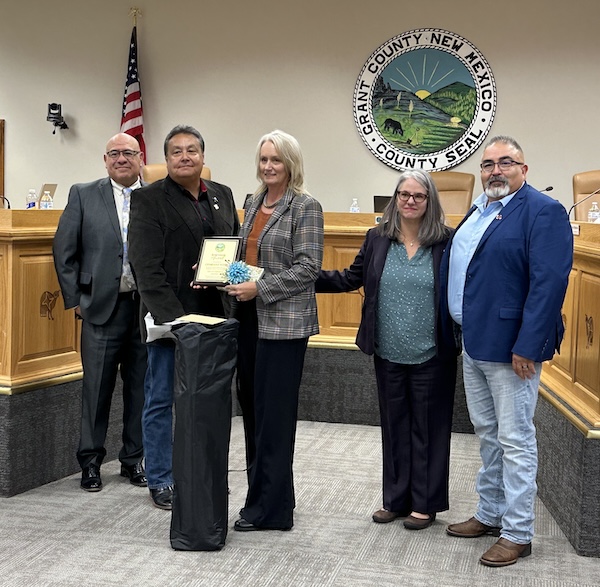
 Retiring County Manager Charlene Webb, center, receives items of appreciation for her service from county Commissioners, from left, Eddie Flores, Chris Ponce, Nancy Stephens and Eloy Medina
Article by Jason Weiland and photo by Mary Alice Murphy
The Grant County Board of Commissioners voted 4-1 during its regular meeting on October 22, 2026, to approve a one-year moratorium on data centers and directly supporting infrastructure in unincorporated Grant County. The decision came after nearly an hour of public comments, a formal public hearing and considerable discussion among commissioners about the county's responsibility to protect its residents, while respecting private property rights and potential economic development.
Commission Chairman Chris Ponce and Commissioners Eloy Medina, Nancy Stephens and Eddie Flores voted in favor of Ordinance O-26-03. Commissioner Tom Shelley, who participated remotely, voted against it. The commission adopted the original version of the ordinance rather than amended language that had been circulated before the meeting.
The meeting also included a public hearing on proposed solid waste fees for fiscal year 2027, a presentation explaining county property tax bills, a review of county investments and recognition of retiring County Manager Charlene Webb. Following an executive session, commissioners appointed Andrea Montoya as interim county manager, effective October 25, 2026, at an annual salary of $130,000 while continuing her existing responsibilities.
The proposed data center moratorium brought a large number of residents to the meeting, many of them concerned about Site Layer 1, a proposed data center and renewable energy development associated with Granite Renewables on ranchland in southern Grant County. Company representatives had presented preliminary information about the project at the commission's October 8, 2026, regular meeting, but residents said that presentation had left important questions unanswered.
Allyson Siwik, executive director of the Gila Resources Information Project, was among the first to address commissioners during public input. She said she had attended the October 8 presentation and came away with more questions than answers, particularly about the project's energy sources and water requirements. "I'm still unclear about this project being a data center operating off of 5,000 acres of solar with battery storage or powered by the 300 MW of natural gas that could emit over 1 million tons a year of carbon emissions and other air pollutants, or maybe it's both," Siwik said.
She questioned the developer's statement that a closed-loop cooling system would use less than 25 acre-feet of water annually, asking whether that figure included construction, maintenance, flushing the cooling system and cleaning solar panels. She also cited the scale of the proposed development, saying it could initially occupy approximately 8,000 acres, with options involving additional ranchland. "This is precisely why the county's data center moratorium is needed," Siwik said, "to allow the commission a reasonable amount of time to gather expertise, information and public input to evaluate the need for county-level rules to safeguard public health and county resources from data centers."
Siwik emphasized that the ordinance should address future proposals as well as the one currently under discussion. She urged commissioners to approve the original moratorium language rather than the amended version.
Cornell Trevino, regional representative for the Continental Divide Trail Coalition, expressed concerns about the project's proximity to the Continental Divide National Scenic Trail and its potential effects on groundwater. He said the coalition was not categorically opposed to data centers but wanted the county to examine the consequences of large-scale development in a dry region where communities already depend on limited water supplies. "We are a dry state, and it's very important that we protect the integrity of us as a people," Trevino said, describing water as a life-giving resource. He asked commissioners to consider the concerns of residents in Grant and Hidalgo counties and examine the proposed project's water and natural gas requirements before allowing development to proceed.
Lawrence Hurt, the ranchland owner involved in the proposed development, offered a different perspective. He acknowledged that he would benefit financially from the project but argued that the county and its residents could benefit as well. "I'm opposed to a moratorium on this project. I am the landowner. And yes, I do stand to benefit from it," Hurt said. He explained that his family had lived off the land in New Mexico since 1909 and clarified that his grandfather had homesteaded in Luna County rather than Grant County. Responding to a question raised at an earlier meeting, Hurt said the proposal contemplated leaving existing wells in production for livestock and wildlife.
Hurt compared the potential revenue from the project with payments associated with two solar energy developments in Luna County. He cited projected tax revenue and payments to that county, arguing that a large energy development could generate substantially more public revenue than continued livestock production on the same acreage. "The primary beneficiary of this project would be Grant County and the citizens of Grant County," Hurt said. "The tax benefits could be significant."
He also raised concerns about the government's authority to restrict the use of private land. "Under the Fifth Amendment, I have a constitutional right to use my property as I see fit," Hurt told commissioners. "A moratorium would restrict my property right to get the most and best possible value for the property." Hurt said he believed continued communication between the developer, county officials and residents would be a better approach than imposing a moratorium.
One of the youngest speakers was a 10-year-old girl who introduced herself as Laura. She told commissioners that she had been born prematurely and that her lungs had not been fully developed at birth. Her parents had worked hard to keep her healthy, she said, and her lungs had grown stronger as she got older. "I like to play soccer and hike in the Gila," Laura said. "But some people's lungs don't get better."
She explained that she worried about children with respiratory problems, including a friend named Natalie who has asthma. Laura said she did not want future generations to face additional problems with air quality. "My parents said anyone could come and talk to you. So, I wrote down my concerns about the data centers and here I am," she told the commission. "After what I have said, I would like you to consider not letting a data center come here."
Her comments drew applause from the audience.
Dave Becker urged commissioners to approve the original ordinance. He said he had been confused when he saw two versions in the meeting materials and worried that the amended language might weaken the county's ability to stop development while regulations were being studied. "I think the important thing here is that the Grant County community has asked for a complete halt to development of data centers to give the county time to study and adopt reasonable regulations on such projects," Becker said.
He questioned whether the amended version would allow developers to continue activities that could create momentum toward construction before the county had completed its review. Becker argued that the moratorium needed to provide a meaningful pause rather than simply delaying the final stages of a project.
The commission also heard from representatives of Site Layer 1, who opposed the ordinance and argued that the project was still in an early planning stage.
Blake Marcus, who identified himself as the project developer for Site Layer 1 LLC, asked commissioners to work with the company rather than impose a moratorium. "I stand before you to ask the board not to enact a moratorium, but instead work collaboratively towards the best possible outcome for your community," Marcus said.
He explained that the company had not finalized commercial negotiations involving power, water, natural gas or fiber connections. Those details, he said, would become clearer as the project moved forward. Marcus reported that environmental due diligence had been completed and an air permit application submitted. He said the company planned to submit a large-load power application on October 28, 2026, with results expected around February 2027. Those results would help determine the project's eventual scope and size.
Marcus also described a separate renewable energy proposal involving 715 megawatts of solar generation and 715 megawatts of battery storage. He argued that the solar and storage facilities would connect to the regional electrical grid and should not automatically be treated as infrastructure serving a data center. "Our project solar and storage is independent of a data center as it connects to the regional grid owned by Tri-State and in front of the meter," Marcus said.
He described the proposed investment as potentially involving approximately $1.5 billion in infrastructure, with up to 1,000 construction jobs and 50 permanent jobs. Those figures were projections offered by the developer, not established employment or revenue commitments.
Marcus said the company was willing to provide its environmental due diligence materials to the commission and community for review. He argued that the ordinance's language was too broad and could interfere with renewable energy projects that were not exclusively intended to serve a data center. "We have a generational opportunity to increase the tax base of Grant County," Marcus said. He asked commissioners either to reject the moratorium or clarify that it would not apply to independent electricity generation and storage projects.
Attorney Adrienne Bell of Holland & Hart, representing Site Layer 1, raised similar objections. She argued that the county could begin developing regulations without stopping work on a project that had not yet been fully defined. "The county can begin that work now without a moratorium," Bell said. "An open-ended pause, by contrast, creates real uncertainty. Financing, interconnection, and permitting timelines depend on regulatory predictability, and a project cannot simply be paused and restarted in a year later."
Bell suggested that a defined regulatory schedule and a community benefits agreement could give the county opportunities to address local concerns without imposing a moratorium. She also questioned language that might apply to solar generation or battery storage simply because electricity from those facilities could eventually serve a data center. "We respectfully ask the county, before adopting any moratorium, to clarify that it does not apply to front-of-the-meter generation or storage," Bell said.
Other residents disagreed with the developer's position and said the county should not rush to accommodate a project before understanding its potential effects.
One speaker questioned the level of public involvement during the company's earlier presentation, saying technical problems had made portions difficult to hear and that residents had not been given sufficient opportunities to ask questions. "Community engagement is a two-way street," the speaker said. "We showed up, but the company has not."
Another resident, who described working with local farmers and ranchers, said he valued the ability to manage private property without unnecessary government interference. However, he argued that reasonable rules were necessary when one person's activities could affect neighboring properties. He recalled growing up when families commonly burned household trash in barrels and explained that practices changed as people learned more about their effects on neighbors. He compared those restrictions with limits on outdoor fires and noise. "I'm all for local business development. I'm all for investment in our communities, but we have to ask ourselves at what cost does that come into our communities?" he said.
Paul Walmsley, a Grant County resident and landowner who identified himself as an engineering manager for a company involved in the artificial intelligence industry, urged commissioners to examine the long-term consequences of data center development.
Walmsley said the facilities could place demands on water, energy, land and the quiet environment valued by residents. He questioned whether the county had enough information to determine if the benefits would outweigh those costs. "To assess the value of these data centers to Grant County, we must consider whether these long-term claims lasting over decades will provide sufficient benefits to Grant County citizens," Walmsley said. "I don't believe we know that yet."
He also questioned whether services provided by the proposed facilities would directly benefit local residents. "Why the rush?" Walmsley asked. He urged commissioners to use the moratorium to make informed decisions rather than respond to development timelines established by private companies.
Another speaker reported that a petition supporting the Grant County data center moratorium had reached 772 signatures as of the morning of the meeting. She thanked commissioners for responding to residents' concerns and shared a Spanish saying about helping others today because that assistance might someday be returned. "The work that you do in this room impacts future generations," she told commissioners.
Anna Wayland questioned the relationship between the proposed solar generation facilities and the natural gas infrastructure discussed in connection with the project. She said she remained skeptical that the energy development would proceed independently if the data center were not built.
Other residents asked commissioners to retain the original ordinance language and expressed concern about relying on information supplied by companies with financial interests in a project.
Kevin Hurst, a Grant County resident, discussed the importance of public access to county documents. He said he had difficulty locating copies of the proposed ordinance and suggested that draft documents be made easier to find online before public hearings. Hurst also asked people in the audience who supported the original ordinance to raise their hands. His request drew a visible response from those attending.
After the public input period, commissioners turned to a more personal matter, recognizing County Manager Charlene Webb as she prepared to retire after approximately 25 years in public service. Ponce praised Webb for the work she had done behind the scenes, explaining that residents did not always see the time and effort required to manage county operations. "She's always here," Ponce said, recalling conversations with Webb late on Friday afternoons when he wondered why she had not already gone home.
He said Webb continued working because she wanted county employees to have the support they needed and county business to be handled properly. Ponce also reflected on their years working together and credited Webb with helping commissioners understand difficult issues, including the county's efforts to keep Gila Regional Medical Center operating during a period of uncertainty. "What you've helped me with and what you've taught me and where you've kept me in line, I really appreciate that," Ponce told Webb. "If you ever need anything, I will always be here for you."
Stephens described Webb as professional, competent and fair. She said Webb had been especially helpful during her first two years as a commissioner. "It's been a real comfort to me knowing that whatever calls or emails I get, I have a helpline, and it's your number," Stephens said, drawing laughter. She thanked Webb for keeping her personal opinions out of county business and concentrating on making sure government procedures were followed correctly.
Other commissioners expressed appreciation for Webb's willingness to answer questions, return telephone calls and help them work through difficult decisions. When Webb spoke, she became emotional as she reflected on her career. "In the letter I read when I announced my retirement, I told you what an honor it was to be a public servant for 25 years," she said. "Twenty-four of those are as a county manager. People think I'm nuts for doing it for 24 years."
Webb said she had served three counties and had returned to Grant County because it was home. "This has been extra special for me because this is my home. I was born and raised here and am going to retire here," she said.
She credited commissioners, elected officials and county employees with making her work possible. "We don't always agree, but at the end of the day we come out all moving in the right direction," Webb said. "I couldn't have done this for this long without the support of everyone in this room."
Following the recognition, County Treasurer Patrick Cohn presented information on how residents can read and understand their property tax bills. Cohn explained that taxpayers should begin by confirming the account or parcel number, property description, ownership information and tax year. He described how New Mexico calculates property taxes using assessed value, applicable exemptions and certified mill rates.
Using a hypothetical example, Cohn showed how a net taxable value of $58,000 and a combined tax rate of 25 mills would produce an annual tax bill of $1,450. "One mill equals $1 per $1,000 of net taxable value," Cohn explained. He emphasized that the figures in the example were instructional and did not represent an actual Grant County tax bill.
Cohn also explained that the treasurer collects money for multiple taxing entities and that not all property tax revenue collected by the county becomes revenue available for county government operations. He reviewed payment options, deadlines and the consequences of delinquent taxes, encouraging residents to examine their statements and contact the appropriate county office when they had questions.
The commission then opened the formal public hearing on Ordinance O-26-03.
Several speakers returned to the podium to place their concerns on the hearing record. Trevino again emphasized the importance of protecting water resources, drawing on his experiences working with rural and Indigenous communities throughout New Mexico. "I can't express how hurtful it feels when you see our waters poisoned and our children suffer," Trevino said.
He urged commissioners to consider the consequences of decisions that could affect future generations. "The lives and the generations of our children lie on the decisions that we make today," he said. "Let's do our due diligence. Let's protect what's important."
Siwik also returned to express support for the ordinance and requested that comments made earlier in the meeting be included in the hearing record.
Hurst spoke about groundwater and the area's dark skies. He explained that he had researched water conditions before moving to southwestern New Mexico and now helped operate an astronomy program at City of Rocks State Park. "I share the night sky with the public. I love to do that," Hurst said. He urged commissioners to consider light pollution from any large development and protect the dark skies that attract visitors to the area.
After closing the hearing, Ponce moved to approve the original version of the ordinance. Ponce explained that the moratorium was not intended to permanently reject data centers. Instead, he said, residents had asked commissioners to obtain reliable information before allowing projects of this scale to proceed. "It's not a thing we're saying not to do it, but the public has been reaching out," Ponce said. "They are looking for more information, and they want information before some of this proceeds." He acknowledged the difficulty of balancing private property rights with the county's responsibility to protect the public. He said questions involving constitutional rights and the extent of the county's legal authority would need to be addressed by attorneys.
Ponce also made clear that approving the moratorium would not be enough by itself. The commission would have to use the coming year to gather information and determine what regulations might be needed. "I hope that this commission does what it says it's going to do. Get information for the public," Ponce said. He warned against treating the vote as a symbolic accomplishment without following through on the work residents were asking commissioners to undertake.
Ponce expressed frustration that the developer had not approached commissioners earlier in the planning process. He said residents and local reporting had brought the proposal to the commission's attention, and the company could have provided information before public concerns reached their current level. "What happened to all the dialogue prior to this?" Ponce asked. "What happened with you guys sitting down with us or with me or with someone and saying, 'Hey, this is what we're looking at.' That's dialogue."
He said the company should not underestimate local residents' ability to understand complicated proposals. "Think of us as we are very intelligent people. We've been here. We care about our county," Ponce said.
Shelley questioned the original ordinance's language and explained why he had worked with Stephens on proposed amendments. He said the word "develop" could be interpreted broadly enough to prevent environmental studies and other preliminary work needed to determine whether a project could satisfy state and federal requirements. "My concerns were that the language of this original moratorium is ambiguous," Shelley said.
He argued that the county should not interfere unnecessarily with information gathering that could help answer the public's questions. Shelley also questioned whether county staff had the expertise to regulate matters already overseen by state agencies. "I don't think we have expertise to even contract a reasonable contract to study things that are listed in this list," Shelley said. He explained that the proposed amendments were intended to focus the county's work on matters within its authority while encouraging cooperation with agencies responsible for water, energy and other technical issues.
Shelley also raised concerns about the possibility that a large solar development or other energy infrastructure could affect electricity costs for county residents. He believed the state Public Regulation Commission and other regulatory agencies were better positioned to evaluate those questions. "I don't think the language was weakened. It was just clarified," Shelley said.
Flores said he had spent considerable time reviewing the proposal and responding to residents who contacted him. "I've listened to folks. I've taken their phone calls. I've read their emails," Flores said. He added that he appreciated people who had taken the time to write or speak at the meeting. He acknowledged uncertainty about what authority the county could exercise over a project on private land, but said he believed the county needed to proceed cautiously.
Flores criticized the developer's earlier presentation, saying representatives should have made a greater effort to appear in person and answer questions before the controversy developed. "The presentation that we had last meeting was poorly done," Flores said. He said residents had difficulty hearing parts of it and that he was disappointed the company had not sent a representative to explain the proposal directly.
Flores said the concerns were not limited to Grant County and that other New Mexico counties were also dealing with questions about data centers. "In the end, I think the most important thing here is our water, the emissions, the environmental impact," Flores said. He supported the original moratorium and said he did not want to change its language.
Stephens then explained why she and Shelley had proposed amendments. She said their intent had been to clarify the ordinance and make sure the county could carry out the work it was promising to do. "It was done in good faith," Stephens said.
She explained that state agencies already regulate matters such as water and energy, and Grant County did not have the staff or technical expertise to duplicate all of that work. "We don't have the expertise nor the manpower to reinvent the wheel and design regulations from scratch," Stephens said.
Stephens acknowledged, however, that the proposed amendments had generated additional questions and concern among residents. "It did seem to create more ambiguity," she said. "I got so many questions, so much feedback about how the language was not strengthened." She said the original ordinance was acceptable and would not prevent the county from working with state agencies or independent experts.
Stephens suggested that county staff begin by identifying the agencies responsible for regulating different aspects of data center development and compiling information about existing rules.
She identified several questions that needed further examination, including whether jobs would go to local residents, how much water and electricity a facility would use, whether utility rates could increase, and who would be responsible for removing equipment after a project stopped operating. "What about noise pollution, light pollution, air pollution?" Stephens asked. "What is the purpose of this development? It's unclear." She also questioned who would pay for cleanup if a facility became obsolete or financially unsuccessful.
Stephens emphasized that she was not opposed to every data center proposal and believed the county could eventually determine whether such development could be done responsibly. "This is a legal pause," Stephens said. "And there's nothing wrong with having a legal pause instead of just a handshake."
She compared the moratorium to slowing a vehicle when there might be danger ahead. "If you're driving and you hear like that there might be a danger ahead, you tap the brakes. You don't speed up," Stephens said. "There's no hurry. We can pause. A year's not that long." Stephens said the county could amend or rescind an ordinance if circumstances changed and that the commission should not be afraid to take time to make an informed decision.
Following the discussion, the clerk conducted a roll-call vote. Ponce, Medina, Stephens and Flores voted yes. Shelley voted no. The ordinance passed 4-1, drawing applause from members of the audience.
The commission next opened a public hearing on Resolution R-26-60, concerning solid waste fees for fiscal year 2027.
Webb explained that the proposed resolution would establish a fee of $26 per month per billable account, plus applicable tax. The recommendation was based on projected expenses and revenues for the county's solid waste operation. She said the county had examined several possible fee levels, with the proposed amount bringing the operation close to breaking even. "$26 puts you at near break-even point," Webb told commissioners.
She explained that the county should not generate unnecessary excess revenue from the enterprise fund, but also needed to collect enough to cover the cost of providing the service.
Shelley questioned whether the draft resolution clearly identified the fee as a monthly charge. "I'm looking at the ordinance language and to me, it's not clear if this is saying $26 a year or $26 a month," Shelley said.
Webb agreed that the wording should be clarified and said the resolution could be amended to specify $26 per month, plus tax, for each billable account. She emphasized that the commission was conducting the required public hearing, not adopting the resolution that day. Commissioners were expected to consider the fee at a subsequent meeting in November 2026, following the required notice period. The hearing closed without final adoption of the proposed fee.
During elected officials' reports, Sheriff Raul Villanueva thanked Webb for her support during his time in office. "We had some challenging times, some good times," Villanueva said. He told Webb he appreciated her guidance and wished her well in retirement.
Cohn reported that the 2026 property tax bills were being prepared for mailing. He said the process had been more complicated than usual because of changes involving state Department of Finance and Administration procedures, but his office had worked through the issues. He said he was confident the county would send accurate tax statements.
County Clerk Connie Holguin reported that her office was continuing preparations for the November 2026 election. She thanked election workers and staff and reminded residents of early voting opportunities and absentee ballot deadlines.
Under new business, county Facilities Director Jason Lockett requested permission to remove obsolete vehicles and equipment from the county's inventory so they could be sold at auction. "Up for your consideration is to delete from our inventory 21 vehicles, one trailer," Lockett told commissioners, explaining that the equipment was no longer needed. Medina moved to approve the asset deletions, Stephens seconded the motion, and the commission approved the request without opposition.
Commissioners also approved a $66,800 software agreement for county emergency services operations. The proposal involved a platform intended to support fire and related public safety functions. Flores made the motion, Medina seconded it, and the measure passed without opposition.
The commission then recessed as the Board of Commissioners and convened as the Board of Finance to hear Cohn's report on county investments. Cohn reported that the combined ending value of the county's investments with Martin Capital, Stifel and the Local Government Investment Pool was $22,287,162.71 as of September 30, 2026. The accounts began the reporting period with a combined value of $22,514,505.36. During the period covered by the report, the accounts earned $96,647.70 in interest income. Reported market value changes were negative $323,990.35, resulting in a net decline of $227,342.65, or approximately 1.01 percent of the beginning portfolio value.
Cohn explained that changes in the market value of bonds and certificates of deposit do not necessarily represent realized losses. Fixed-income investments can decline in quoted market value when prevailing interest rates rise, even though the county may still receive the contractual principal and interest if securities are held to maturity and the issuers meet their obligations. He said the county would continue monitoring investment maturities, liquidity and compliance with its investment policy. The Martin Capital account ended the period at approximately $9 million, Stifel at $13,177,430.58 and the Local Government Investment Pool at $100,043.50.
Stephens asked about the market value decrease and whether the county should reconsider its investment approach. Cohn attributed much of the change to interest-rate and market conditions and said he would continue monitoring the portfolio's performance.
After reconvening as the Board of Commissioners, Flores thanked the county road department for responding to problems caused by recent weather. He said residents had contacted him about road conditions and that he had received follow-up messages expressing appreciation for the work being done. "I've been getting follow-up emails thanking me for them getting there," Flores said. "They understand some roads are getting worked on, some roads take priority." He said the department was dealing with a substantial workload, but residents were noticing the improvements.
Shelley raised concerns about the future of Ben Altamirano Field and the Silver Consolidated School District's plans for athletic facilities. He said the community had invested considerable time and money in the existing fields and questioned what would happen if the school district moved its activities elsewhere.
Shelley suggested that the county encourage discussions between the town of Silver City and the school district about the facility's future. He proposed that commissioners consider sending a letter requesting dialogue and information about a possible transition plan.
Stephens agreed that the issue deserved attention. She said residents had contacted her about the recreational value of the fields and raised questions about the potential use of artificial turf at other facilities. She also expressed concern about the amount of artificial turf that could eventually require disposal at the regional landfill when playing surfaces were replaced.
Stephens reported receiving requests for the commission to support stronger consumer data privacy protections, potentially through state legislation. She suggested the issue deserved further examination, particularly in light of concerns about scams and misuse of personal information.
She also discussed a recent meeting on rural health care involving representatives of state legislators and health care organizations. Housing emerged as one of the major concerns, she said, including housing for health care workers and modifications that would allow older residents to remain in their homes.
Stephens said transportation following hospital discharge was another issue requiring attention, particularly for patients who lacked insurance coverage or another reliable way to get home.
Ponce returned to the discussion of Ben Altamirano Field during his report. He talked about the practical advantages of having junior varsity and varsity softball teams play on nearby fields, including easier scheduling, opportunities for coaches to move players between teams and convenience for families attending games. He questioned whether alternative facilities would provide the same benefits and raised concerns about lighting, parking, traffic and the effects on nearby residents.
Ponce said the existing fields represented a substantial community investment and encouraged school officials to consider those factors before making final decisions about their future.
Later in the meeting, commissioners recessed until the afternoon and entered an executive session under the New Mexico Open Meetings Act.
After returning to open session, the commission stated that only the matters identified on the agenda had been discussed and that no action had been taken during the closed session.
Ponce then moved to offer Andrea Montoya the interim county manager position beginning Sunday, October 25, 2026, at an annual salary of $130,000. The motion specified that Montoya would continue performing her existing responsibilities while also carrying out the duties of county manager until the commission selected a permanent replacement. Flores seconded the motion, and the commission approved the appointment without opposition.
The meeting adjourned following the vote.