








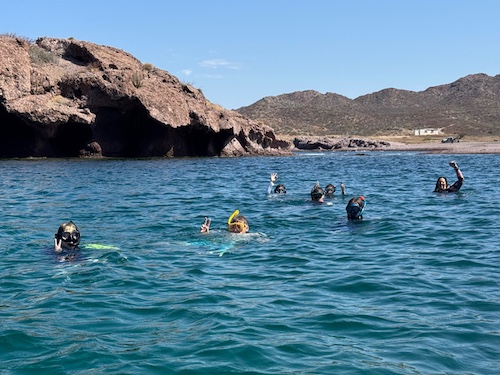
 Western New Mexico University science students and WNMU Professor of Biology Manda Jost, Ph.D., far right raising her hand, research in the Gulf of California during a monthlong marine biology field course on the Sonoran coast of MexicoSILVER CITY, NM — Western New Mexico University science students recently returned from a strenuous marine biology field course in the Gulf of California, where they spent two weeks conducting field research on the Sonoran coast of Mexico.
The six-credit summer course, led by WNMU Professor of Biology Manda Jost, Ph.D., and Assistant Professor of Biology, Caleb Laughran, Ph.D., pushed zoology and wildlife majors to their physical, mental and academic limits.
"It was beautiful to see," said student Azlan Kozimor, describing the landscape where the Sonoran Desert meets the ocean. "Literally on the beach, there was just cactus and desert scrub that we're kind of used to here, but then the ocean was steps away."
The extreme climate provided a real-world lesson in physiology. At night, temperatures rarely dropped below the 80s, forcing students to sleep on top of their sleeping bags. During the day, they battled high humidity and temperatures well above 90 degrees.
To beat the heat and gather data, the team adapted to a challenging schedule. They woke before dawn to catch low tides, spent hours snorkeling to survey marine life, and used a field laboratory packed with microscopes and dissection tools.
To ground their field experiences, Jost required students to read "Sea of Cortez: A Leisurely Journal of Travel and Research" (also known as "The Log from the Sea of Cortez"), co-authored by John Steinbeck and marine biologist Ed Ricketts. "It's about 40 percent science and 60 percent philosophy," Jost said. "I have students read it because it describes a spontaneous and naive exploration of marine biodiversity in that region, very similar to the students' own, that eventually produced important data and lasting research."
"We went to a sea turtle rescue facility called CRRIFS, run by wildlife veterinarian Elsa Coria Galindo," student Devyn Scott said.
The acronym stands for Centro de Rescate, Rehabilitación e Investigación de Fauna Silvestre A.C., or the Wild Fauna Rescue, Rehabilitation and Research Center. The group helped treat a green sea turtle injured by a boat propeller. Scott noted the visit underscored the high stakes of their climate research, adding that higher temperatures cause more sea turtles to be born female, creating an ongoing ecological imbalance.
Students also pursued independent research projects during the expedition:
Andrea Chavez studied El Niño's effects on octopi's behaviors, tracking camouflage and movement patterns.
Lilith Kafka explored stingray species diversity based on unique structural markings.
Uriel H'Luz documented crab populations within the intertidal zones.
Ben Roe focused on sea anemones, identifying five species, including one growing on a mangrove mollusk.
Ben Horner recalled a conservation effort in which the class filled 15 bags of trash during a beach cleanup and later discovered an 8.5-meter Nemertean ribbon worm.
The physical demands required what student Zach Horner described as learning to live with constant moisture, blisters and exhaustion. To encourage teamwork, Jost introduced a field professionalism and citizenship metric into the course grading, evaluating students on their positive attitude, active participation and consistency with camp chores.
While the university plans to alternate this trip with a broader field biology course in future summers, this immersive program remains a unique asset among regional universities.
"When you come out with your degree, there are thousands of people with the same degree as you," Horner said. "The only difference is if you have that real-world experience, if you've worked with those tools and techniques. Most jobs prefer someone who has the experience."
Students at a university situated on the doorstep of the Gila Wilderness believe robust field programming is one of the university's greatest assets and a key part of its identity.
"Every person here is doing it because they love it; it's a way of life," Scott said. "I would love for the new administration to come out to the lab and see what we're about. This experience is unlike anything we can get in a classroom, and it deserves support."