







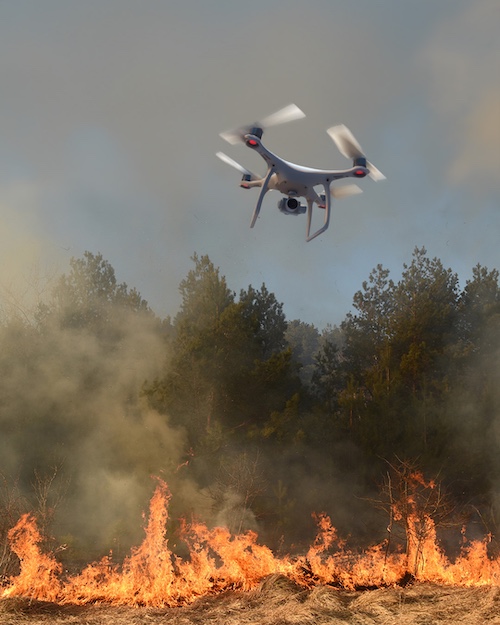
 Image of high-tech drone helping fight fires.SILVER CITY, NM — For Western New Mexico University alum Kade Evans, lessons learned during his time at the university are put to the test every day in the high-pressure world of firefighting and emergency services.
During Evan's time at WNMU, he was a bridge-builder who understood early on that effective communication and community trust are the bedrocks of any successful public service initiative. These values, fostered in the inclusive environment of Silver City, now serve as the core of his professional life in firefighting.
Reflecting on his academic years, Evans emphasized that the integrated community identity at WNMU was instrumental in preparing him for the complexities of emergency response. Unlike traditional institutional models, WNMU operates seamlessly within the local fabric, allowing Evans to develop a deep appreciation for the community he now protects.
"At WNMU, I wasn't just building a resume; I was building the mental and emotional discipline required for the field," Evans remarked. "The university provided a space where leadership wasn't just a concept, but a practice. The ability to stay calm, communicate clearly under pressure and put the community first are skills I honed on that campus."
Today, Evans translates those foundational experiences into a demanding career in firefighting, he helped fight the Hummingbird Fire and others burning in the region. His daily work involves not only the physical rigors of supporting fire suppression but also the critical human element of emergency medical response and public safety education. He credits his professors and mentors at WNMU for challenging him to move beyond technical proficiency toward a more holistic understanding of community service.
Beyond traditional fire suppression and emergency medical response, Evans is actively pursuing a dream to integrate Unmanned Aerial Systems—or drones—into firefighting operations. He envisions a future where drones provide real-time data, thermal imaging and aerial reconnaissance to help fire crews navigate hazardous terrain and identify hotspots more efficiently.
In Southern New Mexico, UAS have become essential tools for managing wildland blazes like the Hummingbird Fire. Equipped with infrared technology, these drones provide real-time reconnaissance by peering through dense smoke to identify hidden hotspots and monitor spot fires near vulnerable areas like the Willow Creek Subdivision. "Beyond observation, they enhance operational safety by conducting aerial ignitions; dropping small incendiary devices to start controlled backfires allows crews to secure defensive lines without sending personnel or piloted aircraft into hazardous 'dead man's zone' conditions," Evans said.
In the sensitive terrain of the Gila Wilderness, drones offer a low-impact solution for maintaining situational awareness without the heavy footprint of traditional mechanized equipment. They provide ground crews with a vital bird's eye view to track fire movement toward natural features like Iron Mesa. However, incident commanders stress that while agency drones are critical for protection, unauthorized public drones pose a severe risk. Such interference triggers Temporary Flight Restrictions that force the grounding of all firefighting aircraft, stalling the very technology being used to safeguard the community.
"The ability to lead with empathy and maintain a direct connection with the citizens we serve is essential," Evans said. "But we also have to look at how technology can make us safer and more effective. My goal is to bring those two things together—the human element and the latest in drone technology—to better protect our community."
Evans' transition from a campus leader to a first responder illustrates the profound potential of a WNMU education to produce graduates who are both technically skilled and deeply community centered. His work today serves as a vital safeguard for the Silver City area and a reminder of the university's role in shaping the region's essential workforce.