








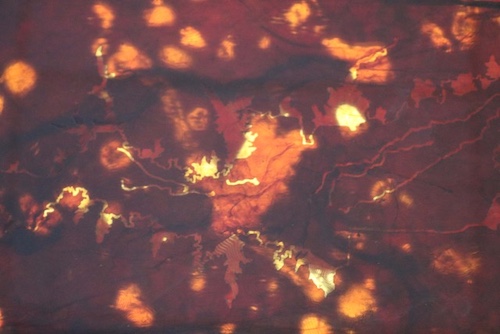
 Blanchette's exhibition includes lightboxes filled with water from the Gila River, spotlighting the live growth of SCOBY (bacteria and yeast cultures), lit from belowSILVER CITY, NM —Claire Fall Blanchette is an interdisciplinary artist exploring biology, geology, and human impact. As artist-in-residence at Western New Mexico University (WNMU), she focuses on the high desert and the Gila Watershed's ecological narratives. Ground Truthing, a provocative exhibition by Blanchette, opened at The Francis McCray Gallery of Contemporary Artat WNMU on March 19. The exhibition, which runs through April 9, invites viewers to reconsider their relationship with extractive high desert landscapes through a unique fusion of biological processes, geological history, and local ecology.
At the heart of Ground Truthing is a radical collaboration with the living world. Blanchette moves beyond traditional representation. She uses "biological participants"—specifically bacterial and yeast cultures (SCOBY)—grown with water drawn from the Gila River. By using these local water cultures, the artist lets the river act as a primary creator, not just a subject.
The exhibition features a striking mix of materials reflecting Silver City's history. Blanchette pairs rocks from Boston Hill—a site known for its industrial mining legacy—with mycelium. Mycelium, the root-like structure of fungi, can reclaim and repair compromised soil. This pairing creates a dialogue between rigid extraction history and the flexible potential for healing.
For Blanchette, New Mexico's visible environmental dualities sparked immediate interest. "Having the Gila Wilderness next to a mining town is interesting," she said. "We have to extract to exist, but we can consider other ways to impact ecosystems."
The aesthetic of Ground Truthing is defined by visceral, skin-like membranes. Blanchette uses hanging panels to show organic textures that metaphorically express the desert's fragile state. These "skins" were as unpredictable as the environments they represent. During installation, several mycelium panels curled and twisted in reaction to Silver City's arid, high-altitude air. Blanchette did not correct these movements. Instead, she embraced them, citing the unpredictability of living organisms as central to her method.
"I view these organic membranes as both a protective layer and a symbol of vulnerability," Blanchette said. "You must be attuned to your materials to fit your concept, especially when working with natural materials."
Blanchette also connected with local environmental organizations, including the Gila Resources Information Project (GRIP), as part of her research for the exhibition. This community-centric approach mirrors the unique culture she found during her time in the region. Compared to larger urban hubs, Blanchette noted a sense of real community in Silver City and a WNMU. "It feels like there are more things happening here—a lot of community events. I've never experienced a community so close-knit before," Blanchette said.