








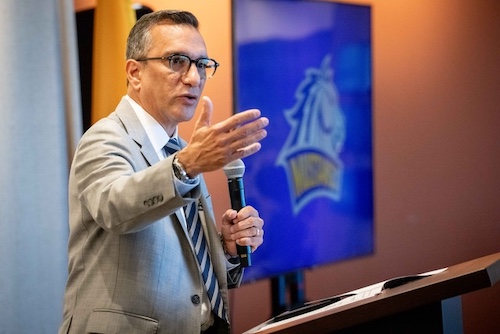
 Western New Mexico University President Jose E. Coll addresses local business leaders at a recent Silver City Grant County Chamber of Commerce meetingSILVER CITY, NM — Presenting the university's $101 million economic impact and laying out a vision for workforce innovation, Western New Mexico University President Jose E. Coll addressed local business leaders at a Silver City Grant County Chamber of Commerce meeting.
Speaking to entrepreneurs and community leaders, Coll framed WNMU as a core economic driver for Grant County, standing alongside mining, arts, tourism and agriculture as a foundation of regional economic resilience.
"Western New Mexico University isn't simply an educational institution; it is one of Grant County's foundational economic anchors," Coll said, stressing the university's year-round financial contribution to the local economy.
Coll detailed the institution's financial footprint across the region, breaking down a dynamic multi-tiered impact:
Direct operations: WNMU generates $33 million in regional economic impact through direct institutional payroll and operational spending.
Student spending: University students contribute an additional $4 million locally through relocation costs, retail purchases and consumer activity.
Alum and business impact: Long-term impacts from alum earnings and local business revenue account for $64 million injected into the local economy.
As one of southwestern New Mexico's largest employers, WNMU provides stable positions across academic, administrative, technical and service sectors. Coll emphasized that university employees form an essential pillar for the local consumer market, purchasing homes in Silver City, Bayard and Hurley while supporting local merchants, contractors and service providers.
"The stable income provided by university employment creates a resilient layer of consumer demand that protects local small businesses, even during more extensive economic downturns," Coll said. He added that WNMU prioritizes local vendors for maintenance, supplies and campus construction projects whenever possible.
Students also drive the local business ecosystem through direct spending, filling essential workforce roles and drawing regional visitors to campus events and Mustang athletic games.
Turning to wider sector challenges, Coll acknowledged that higher education is at a national crossroads defined by shifting demographics and declining public faith. Rural institutions also face a shrinking traditional college-age population.
While statewide initiatives like the New Mexico Opportunity Scholarship have expanded financial access, Coll argued that universities must adapt to serve modern learners. Pointing to an estimated 324,000 adults in New Mexico who have college credit but no degree, Coll stressed the need for flexible academic pathways.
"The rigid traditional model no longer serves students, employers or our state's workforce needs," Coll said. "Higher education must embrace creative approaches that recognize learning wherever it occurs."
Coll advocated for expanding Prior Learning Assessment frameworks developed to grant academic credit for professional experience, military service, industry certifications and workforce training. This approach aligns WNMU academic programs with high-demand regional sectors, such as healthcare, education, management and entrepreneurship.
Closing his address, Coll called on business owners to deepen collaboration with the university by expanding local internships, offering student and faculty discounts to keep spending local and nurturing a community environment that encourages graduates to build their careers in Grant County.
"A strong university creates a strong local economy, and a thriving business community makes Silver City and Grant County a place where students, faculty and staff want to live, work and stay," Coll said.