







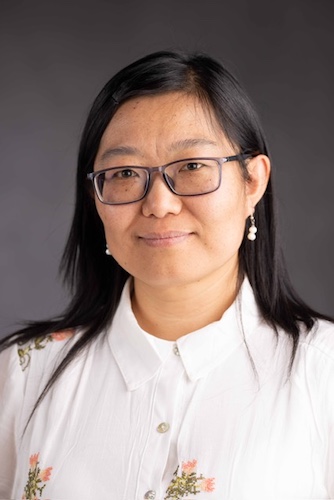
 WNMU Associate Professor and Department Chair of Early Childhood and Special Education, Wenjie Wang, PhDSILVER CITY, NM — How young children build connections between concrete objects and abstract concepts is central to the innovative early childhood education research led by Associate Professor and Department Chair of Early Childhood and Special Education, Wenjie Wang, PhD, conducted in collaboration with Adjunct Associate Professor Annabelle Black Delfin, PhD, a former research director for the Center of Excellence in Early Childhood Education at WNMU. The research explores how young children develop spatial reasoning and mathematical thinking through map-making activities and visual symbols.
The multiyear project, titled the "Treasure Map Experience," was published in a prestigious international peer-reviewed journal. The study investigated how 3- to 5-year-old children use shapes, colors and spatial layouts to represent familiar environments such as classrooms, playgrounds and bedrooms.
A primary finding of the research is that young children consistently prioritize shape over color when creating symbolic representations. When asked to construct maps, children frequently selected geometric shapes to represent physical landmarks—such as using a triangle to depict a mountain or combining circles and lines to represent a table. These symbolic anchors function as crucial bridges in cognitive development, facilitating the transition from concrete physical objects to abstract numerical and spatial reasoning.
"Symbolic anchors can be understood as a clue," Wang said. "This clue, from children's perspectives, shows where they start on their educational path and what kind of understanding they currently possess. From a teacher's perspective, we can see how students try to understand concepts through that clue and determine how to provide further guidance."
The research is grounded in Lev Vygotsky's sociocultural theory and the concept of the Zone of Proximal Development. The theoretical framework points out that learning occurs through social interaction, guided instruction and scaffolded challenges.
"We don't want to dissuade children's imaginations," Wang explained. "We want to see where they are and how we, as teachers and researchers, can encourage learning while also letting their imaginations flourish. The connection between the concrete object and the abstract is also fundamental to mathematical thinking."
Wang emphasized that effective early childhood assessment requires holistic observation and active exchange rather than rigid testing. Because young children may find it difficult to express their complete thoughts solely through drawings, teachers must engage them through meaningful conversations to understand their self-talk and underlying reasoning.
"We also rely on observation and conversations with parents to understand the child as a whole," Wang said. "When a child draws a circle with lines around it, an observer might assume it represents a sun or a spider. But when asked, the child may explain it is a table viewed from above with legs sticking out—representing a three-dimensional object in a two-dimensional format."
The project was conducted in collaboration with local early childhood centers, including the Child Development Center in Silver City and First Presbyterian Child Development Center in Santa Fe. Data collection included observational documentation, video recordings, map artifacts that children made, and child-led map explanations over four years.
Wang noted that the goal of the research is to serve the local community and contribute to nationwide best practices in early childhood curriculum development and pedagogy.
We want people to know that in New Mexico, at Western New Mexico University and our Center of Excellence [Center of Excellence for Early Childhood Education at WNMU], there is research taking place that directly supports our teachers, families and children," Wang said. "Children are researchers themselves. If we don't listen to them, we will never truly understand their thinking process."
Wang and Delfin plan to extend the Treasure Map Experience into a more extensive series of educational resources, focusing on classroom integration, family engagement and community-based learning projects.