







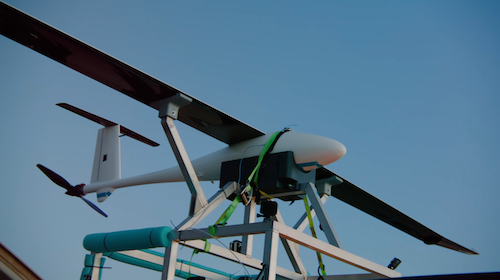
 Otto Aerospace's laminar-flow technology UAV readies for a test flight at Spaceport America in early May 2026 (photo credit: Otto Aerospace)Otto Aerospace Test Flight Video
LAS CRUCES, N.M. (Wednesday, May 20, 2026) – A next‑generation unmanned aircraft featuring cutting‑edge laminar‑flow technology completed a series of successful test flights at Spaceport America earlier this month, marking a major milestone in high‑efficiency aerospace design.
The campaign was conducted by Texas-based Otto Aerospace in collaboration with Spaceport America's longtime customer, Swift Engineering. The aircraft's laminar‑flow airframe is engineered to maintain exceptionally smooth airflow across its surfaces—dramatically reducing drag and enabling long-endurance flight with minimal energy use.
"Otto Aerospace's leading-edge wing technology belongs at a leading-edge commercial facility like Spaceport America," said Scott McLaughlin, Executive Director of the New Mexico Spaceport Authority. "We have hosted a diverse range of aerospace activities in recent years, and Otto's laminar flow breakthroughs represent exactly the kind of innovation that is happening in New Mexico and will reshape the future of the aviation industry."
Part of the aircraft's underlying research was funded through a two‑year contract with the Defense Advanced Research Projects Agency (DARPA) and the Operational Energy Capability Improvement Fund (OECIF). The aircraft supported early work for DARPA's Energy Web Aircraft (EWA) program, which is exploring laser‑based power transfer over long distances. The goal of the EWA program is to use airborne relays to beam energy to aircraft—potentially allowing them to remain aloft indefinitely.
Otto Aerospace independently funded the recent flight test campaign, which was conducted outside the scope of the DARPA and OECIF contract.
"This aircraft proved what we've modeled for years: that high‑efficiency laminar‑flow aerodynamics can deliver extraordinary endurance and performance," said Scott Drennan, president and CEO of Otto Aerospace. "We're proud that Otto's expertise helped advance DARPA's research objectives, and equally proud of our team for executing a flawless flight campaign that pushes aerodynamic science forward."
Otto Aerospace led the design and development of the laminar‑flow airframe, drawing on years of focused aerodynamic research. The results of this work may pave the way for future airborne energy relay systems or new, fuel-efficient, long-endurance aircraft platforms.
Swift Engineering supported the campaign by managing vehicle preparation and providing range and telemetry operations. Swift has been conducting test flights of its own high‑altitude, long‑endurance (HALE) aircraft at Spaceport America since 2020.
"Swift is proud to partner with Otto on this breakthrough," said Hamed Khalkhali, president of Swift Engineering. "The performance demonstrated in flight confirms the promise of laminar‑flow aerodynamics to redefine long‑endurance efficiency for unmanned systems across defense and commercial applications."