







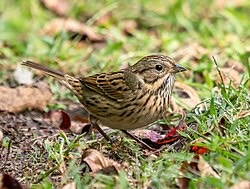
 Photo from Wikipedia Commons by Rhododentrites, Sept. 21, 2025, Greenwood Cemetery, Brooklyn, NY.By Roger Lanse
My birding partner and I were watching a mixture of sparrows, towhees, and juncos feeding on the brick patio in our Arenas Valley front yard just a few days ago, the 22nd of February. "Nothing new to see here," I said to myself, as I focused my binoculars on the mix. Noticing in the other direction a sparrow perched sideways on a dry vertical yucca stalk, I added to my previous thought, "Probably another house sparrow," as they seemed wont to hang out at that particular perch.
As I glassed the sparrow, I detected the streaking on its breast was different. The streaking didn't extend further south than a band across the upper breast, kind of like the 'necklace' of a scrub jay, leaving the lower breast and belly plain grayish-white with no streaking."Aha, says I," suddenly roused up, "the elusive Lincoln's sparrow." Last time we saw one of those was in March of 2016. Although the Lincoln's sparrow has been described as a bit of a skulker, they will flaunt their song from a perch on occasion. Being inside, ensconced in my favorite coffee-drinking chair, I couldn't tell if the bird was doing its occasional perch song or not.
The Gila National Forest's checklist labels the Lincoln's sparrow as an uncommon winter resident. Even though the southern reaches of their breeding range may include Grant County, they prefer to raise their young in more northerly climes.
The literature says Lincoln's sparrows can live as long as seven years and 11 months. A male banded in 1995 in Colorado was recaptured and released in 2002, also in Colorado. Who knew?
John James Audubon first named the sparrow after Maine resident Thomas Lincoln, who, reportedly, accompanied Audubon on an 1833 trip to either northeastern Canada, or Nova Scotia, or the Natashquan Valley in Labrador – take your pick. Audubon writes, "Chance placed my young companion, Thomas Lincoln, in a situation whereby he saw it alight within shot and with his usual unerring aim, he cut short its career." Although, Audubon claims to have been with Thomas when he collected that first one, witnesses later disputed that claim.
According to the Cornell University Ornithology Lab, a recent study of the Lincoln's sparrow researched the relation between bill shape and reproductive success. Digging through the scientific jargon, It seems song quality goes up as the ratio of bill height to width increases. And the girls like the boys with the best song.
The same study claims that female Lincoln' sparrows are more attracted to males which sing on colder mornings than those which tend to sing only on warmer mornings.
Hmm, song quality and cold mornings. Is there a lesson here?