



 Click to Search
Search
[{{{type}}}] {{{reason}}}
{{/data.error.root_cause}}
{{{_source.title}}} {{#_source.showPrice}} {{{_source.displayPrice}}} {{/_source.showPrice}}
{{#_source.showLink}} {{/_source.showLink}} {{#_source.showDate}}{{{_source.displayDate}}}
{{/_source.showDate}}{{{_source.description}}}
{{#_source.additionalInfo}}{{#_source.additionalFields}} {{#title}} {{{label}}}: {{{title}}} {{/title}} {{/_source.additionalFields}}
{{/_source.additionalInfo}}

From Our Place to Yours

Jackie Blurton
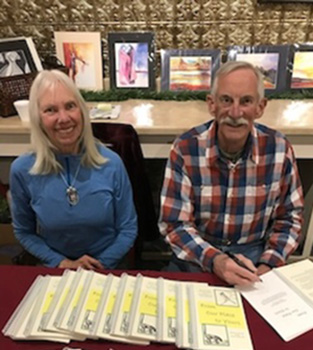
Jackie Blurton and Dr. Roland Shook sign copies of their book, From Our Place to Yours, at the a book signing at the Grant County Art Guild Gallery.

Roland Shook
- Art by Jackie Blurton. Jackie is the Activity Chair of Bird Alliance of Southwestern New Mexico, the Silver City Chapter of the National Audubon Society. www.birdallianceswnm.org .
- Text by Dr. Roland Shook. The late Dr. Shook was a professor of Biology at WNMU from 1992 to 2007. He was a past president of the NM Ornithological Society and Southwest New Mexico Audubon Society.
- From Our Place to Yours previously ran in the Silver City Daily Press from 1999 to 2006.
- Category: From Our Place to Yours
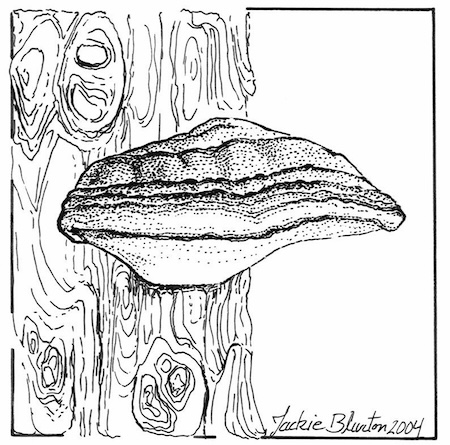
Bracket Fungi
Art by Jackie Blurton
Nature Note by the late Dr. Roland Shook
Bracket Fungi includes tough shelf-like growths on the trunks or limbs of dead or dying trees. Because these fungi live for several years, they are the most obvious group of fungi found in the woods of North America.
- Category: From Our Place to Yours
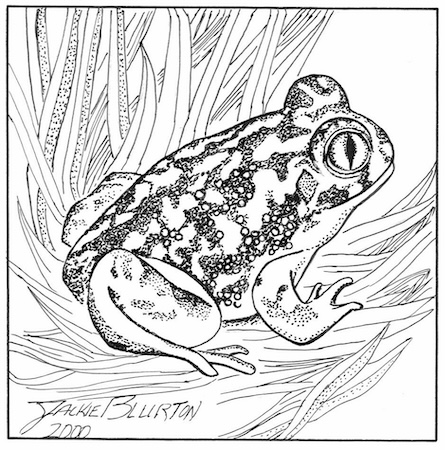
Couch's Spadefoot
Art by Jackie Blurton
Narrative by the late Roland Shook
Spadefoots or spadefoot toads are toad-like burrowing frogs so named for the horny spades on their hind feet. These frogs are well adapted to arid conditions. When the monsoon rains of summer appear, they have the ability to reproduce in a very short period of time. During the dry parts of the year, these frogs remain primarily underground, avoiding the harsh conditions. Sound or vibration caused by rainfall or perhaps thunder is thought to be the trigger that stimulates the emergence of these frogs and the beginning of the breeding cycle.
Couch's Spadefoot is probably the best adapted of all the North American spadefoots. Scientific studies reveal that this frog can remain underground for up to 3 years before emergence. Ninety percent of the breeding occurs on the first night following pond formation and the rate of development is the most rapid of any North American frog.
Secretions from the skin of Couch's spadefoot can be toxic to humans.
- Category: From Our Place to Yours
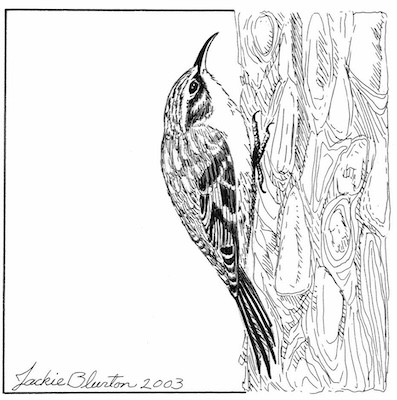 Art by Jackie Blurton
Nature Note by Dr. Roland Shook
There are several species of birds adapted to feed on the trunk or limbs of larger trees. The most familiar are woodpeckers, but nuthatches and creepers are also included in this group.
The Brown Creeper is an inconspicuous species that is often overlooked except by careful birders. Its small size, brownish coloration above, white breast below, very high-pitched vocalization, and its ability to blend with its background while sitting motionless, all make it difficult to detect. It is present in our area at lower elevations only in some winters, preferring coniferous forests at higher elevations to nest and raise a family.
- Category: From Our Place to Yours
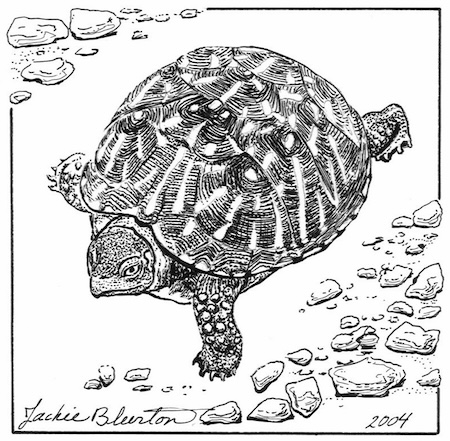
Western Box Turtle
Art by Jackie Blurton
Nature Note by Dr. Roland Shook
Box turtles can completely enclose themselves in their shells. The front of the lower shell, or plastron, is hinged and can be drawn up tightly a
gainst the upper shell or carapace. This species of turtle occurs in suitable habitats from South Dakota, through southern Indiana, south to the Gulf Coast of Texas. From east Texas, it ranges across New Mexico and southeastern Arizona and Sonora.
This land turtle is primarily a prairie turtle. Over much of its range it occupies treeless plains of grass or low shrubs and sandy soil. This species is usually not found in dense woodlands, mountain slopes, or elevation above approximately 6,500 feet. Although active during parts of the day, Western Box Turtles are most often seen crossing highways where its hard shell provides little protection from large vehicles.
- Category: From Our Place to Yours
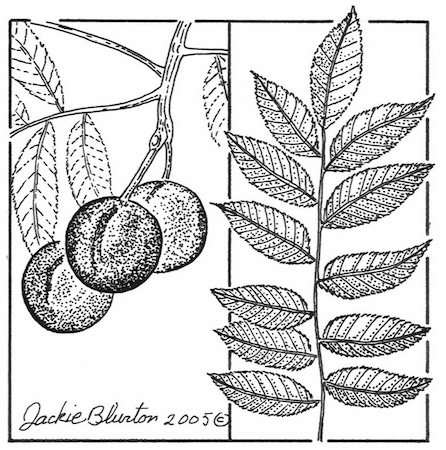 Arizona Walnut
Art by Jackie Blurton
Nature Note by Dr. Roland Shook
Trips to the Gila River along Bill Evans Road, or similar habitats, will often reveal large patches of darkly stained pavement during late summer or early fall. On closer examination, you can often find small pieces of walnut shells produced by automobiles running over walnuts. These patches of shells and nuts attract various species of wildlife which can now dine on the nuts without expending the energy to crack them.
There are six species of walnuts in the United States and the commercial English walnut sold in stores is familiar to just about everyone.
- Category: From Our Place to Yours
 Art by Jackie Blurton
Nature Notes by Dr. Roland Shook.
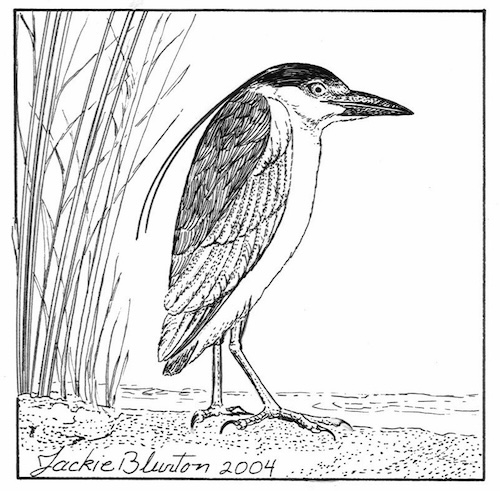
Black-crowned Night Heron
Herons are primarily long-legged, slender-necked waders who frequent marshes, mud flats, and shorelines. Most members of this group have crests or plumes (as shown in this illustration), especially in the breeding season.
This species is smaller and stockier than most herons with relatively short legs and a short bill. The crown and back are black, the wings gray, and the under parts are white.
As the common name would indicate, Black-crowned Night Herons are primarily active at night often roosting in small groups during the day in trees or marshes. This species characteristically stands with its neck pulled in giving it a hunched-up appearance.
- Category: From Our Place to Yours
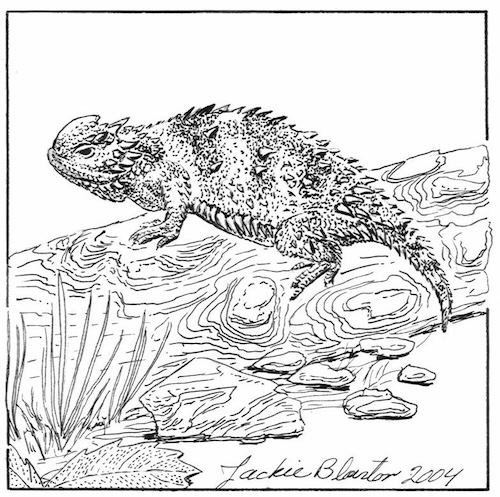
Short-horned Lizard
Art by Jackie Blurton
Nature Note by Dr. Roland Shook
The Short-horned Lizard is one of four species of horned lizards found in New Mexico. Members of the group are characterized by their squat, flattened appearance, and the presence of spines or 'horns' that adorn the head.
This species, including its five subspecies, has the greatest range of any North American horned lizard. In New Mexico, the Short-horned Lizard, occupies a wide variety of habitats from the spruce-fir forests to the semi-desert grasslands. Found in the western two-thirds of the state, it is most common in relatively open habitats.
- Category: From Our Place to Yours
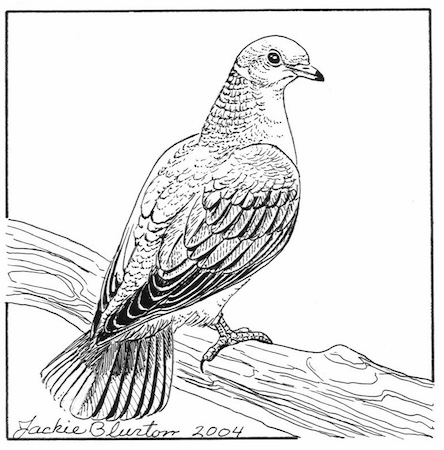
Art by Jackie Blurton
Nature Note by Dr. Roland Shook
Pigeons and doves are common names for members of the order Columbiformes. The name of the Order is derived from the Latin columba which is thought to be imitative of the cry of members of this group. In our area, you have the frequent opportunity to view Mourning, White-winged, and Eurasian-collared Doves, as well as Rock and Band-tailed Pigeons. All doves and pigeons are vegetarians and many feed on the ground in search of seeds. Most members of this group are migratory.






Content on the Beat
WARNING: All articles and photos with a byline or photo credit are copyrighted to the author or photographer. You may not use any information found within the articles without asking permission AND giving attribution to the source. Photos can be requested and may incur a nominal fee for use personally or commercially.
Disclaimer: If you find errors in articles not written by the Beat team but sent to us from other content providers, please contact the writer, not the Beat. For example, obituaries are always provided by the funeral home or a family member. We can fix errors, but please give details on where the error is so we can find it. News releases from government and non-profit entities are posted generally without change, except for legal notices, which incur a small charge.
NOTE: If an article does not have a byline, it was written by someone not affiliated with the Beat and then sent to the Beat for posting.
Images: We have received complaints about large images blocking parts of other articles. If you encounter this problem, click on the title of the article you want to read and it will take you to that article's page, which shows only that article without any intruders.
New Columnists: The Beat continues to bring you new columnists. And check out the old faithfuls who continue to provide content.
Newsletter: If you opt in to the Join GCB Three Times Weekly Updates option above this to the right, you will be subscribed to email notifications with links to recently posted articles.
Editor's Notes
It has come to this editor's attention that people are sending information to the Grant County Beat Facebook page. Please be aware that the editor does not regularly monitor the page. If you have items you want to send to the editor, please send them to editor@grantcountybeat.com. Thanks!
Here for YOU: Consider the Beat your DAILY newspaper for up-to-date information about Grant County. It's at your fingertips! One Click to Local News. Thanks for your support for and your readership of Grant County's online news source—www.grantcountybeat.com
Feel free to notify editor@grantcountybeat.com if you notice any technical problems on the site. Your convenience is my desire for the Beat. The Beat totally appreciates its readers and subscribers!
Compliance: Because you are an esteemed member of The Grant County Beat readership, be assured that we at the Beat continue to do everything we can to be in full compliance with GDPR and pertinent US law, so that the information you have chosen to give to us cannot be compromised.
Submitting to the Beat
Those new to providing news releases to the Beat are asked to please check out submission guidelines at https://www.grantcountybeat.com/about/submissions. They are for your information to make life easier on the readers, as well as for the editor.
Advertising: Don't forget to tell advertisers that you saw their ads on the Beat.
Classifieds: We have changed Classifieds to a simpler option. Check periodically to see if any new ones have popped up. Send your information to editor@grantcountybeat.com and we will post it as soon as we can. Instructions and prices are on the page.